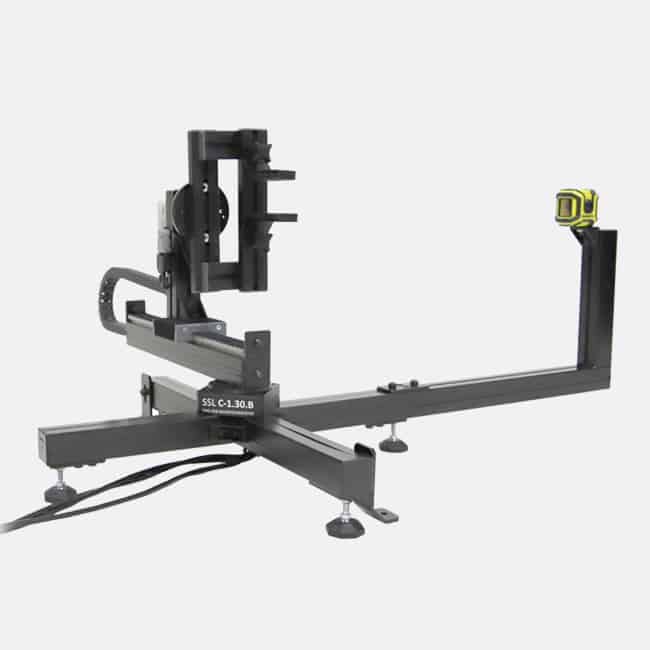
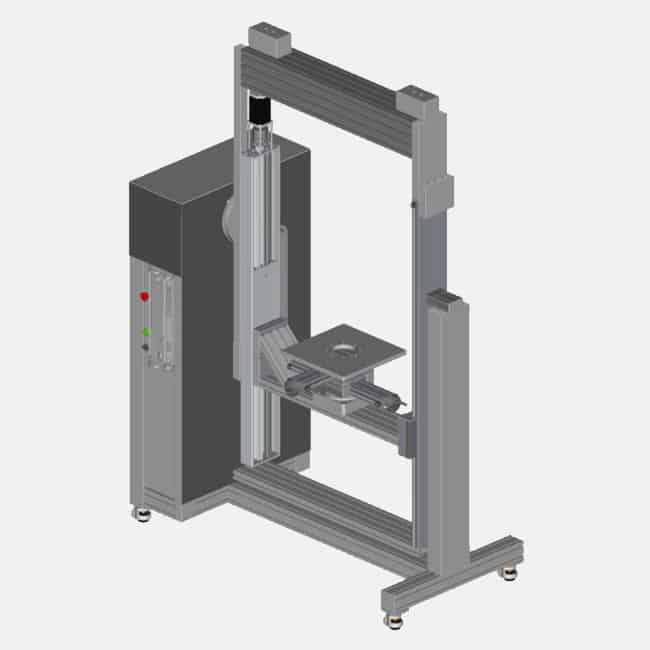
Type A and type B motion goniophotometers are typically used if you wish to test the angular intensity distribution of directional light sources. In type A or type B motion, the device under test is tilted about a horizontal axis, which means that its direction of peak intensity (orientation) moves with respect to gravity during a scan. Typical applications for type A and type B goniophotometers include the measurement of vehicle lighting (for example, automotive headlamps and marker/side lamps), as well as VMS signs and marine, airfield, traffic, train and bicycle lighting.
The SSL Resource range of dedicated IES type A/B motion goniophotometers comprises the type B AUTO 100 and the type A AUTO 1000 models. In addition, the natively type C motion LAMP 30 and LUMI series of goniophotometer models can be converted from type C to type B motion (and vice versa) using an optional accessory kit.
There are two basic families of SSL Resource goniophotometer, allowing you to choose the system that best matches both your technical requirements and budget. The entry-level C1 series comprises the LAMP, LEDI and UNI models, while the LUMI, AUTO and DECO models provide an enhanced level of capability and versatility.
A choice of photodetector is offered, including a precision photometer or a tristimulus colorimeter which adds the capability to measure CIE chromaticity coordinates and CCT. A supplementary spectroradiometer provides for spectral analysis and colour rendering measurements, with the optional ability to extend radiometric measurements into the UV and IR, suitable for testing UVC germicidal lamps or horticultural light sources for example.
Our SSL goniophotometers ship with enhanced software that supports much higher speed, “on-the-fly” measurements. In combination with our high speed photopic detectors, this update enables very fast measurements compared to traditional “stop-and-measure” motion. Full photometric measurements can be performed in a little as 10 minutes now. New goniophotometers are equipped as standard with this capability, while existing systems can often be upgraded with just a software update.
Download a copy of the SSL Resource goniophotometer catalogue.
 Key Features
» Ideal for: torches, bicycle lamps, LED lamps & small LED modules (<300mm)
» Goniometer type: 2-axis motorised, IES type B motion
» Maximum sample size: 30cm x 20cm (L x H)
» Maximum sample weight: 3kg
Overview
The SSL Resource LAMP 30.B is a type B motion goniophotometer that tilts and rotates a lighting product about orthogonal horizontal and vertical axes. In type B motion, the device under test is tilted about a horizontal axis, which means that its direction of peak intensity (orientation) moves with respect to gravity during a scan. Typical applications for type B goniophotometers include the measurement of vehicle lighting (for example, automotive headlamps and marker/side lamps), as well as VMS signs and marine, airfield, traffic, train and bicycle lighting.
The LAMP 30 goniophotometer platform can be supplied configured for either type B or type C motion. Furthermore, a customer may convert their system from type B to type C motion (and vice versa) using an optional accessory kit. This would be useful if measurements of both directional and architectural lighting products were required.
The LAMP 30.B can accommodate samples that measure up to 30cm long by 20cm tall and weigh up to 3kg. The goniometer motion stages feature an angular resolution of <0.01°. The recommended minimum dark room size is 1.7 x 1.7 x 11m, although please note that to satisfy the far-field condition for narrow angle beams, the photometer head may need to be placed at a greater distance.
The angular luminous intensity distribution is recorded as standard using the SSL LC-800 laboratory-grade photometer, equipped with a precision DIN class A photopic sensor head. The system can be equipped with tristimulus colorimeter sensors as an option if you also wish to measure the CIE chromaticity coordinates and correlated colour temperature (CCT) distribution of the lamp. The sensor is supplied with a stand and stray light tube.
The SSL GPM software provides full control of the goniophotometer and records the luminous intensity distribution from the sample under test. Additional software features for type A/B goniometers include an analysis tool for road surface lighting, a horizontal ISOLUX chart (“bird’s eye” road view) and pass/fail reporting of luminous intensity and illuminance values at defined H, V angles according to various standards, including ICAO, CAP437, UNECE, SAE, FVMSS108 and FAA.
Included as standard are an alignment laser and a laser distance meter. Options include an auxiliary spectroradiometer, a flicker photometer and computer-controlled AC/DC power supplies.
 Key Features
» Ideal for: automobile headlamps & marker lamps
» Goniometer type: 2-axis motorised, IES type B motion
» LUMI 90.B maximum sample size 60 x 50 x 10cm; 10kg
» LUMI 120.B maximum sample size 160 x 80 x 30cm; 20kg
» LUMI 180.B maximum sample size 100 x 100 x 30cm; 40kg
Overview
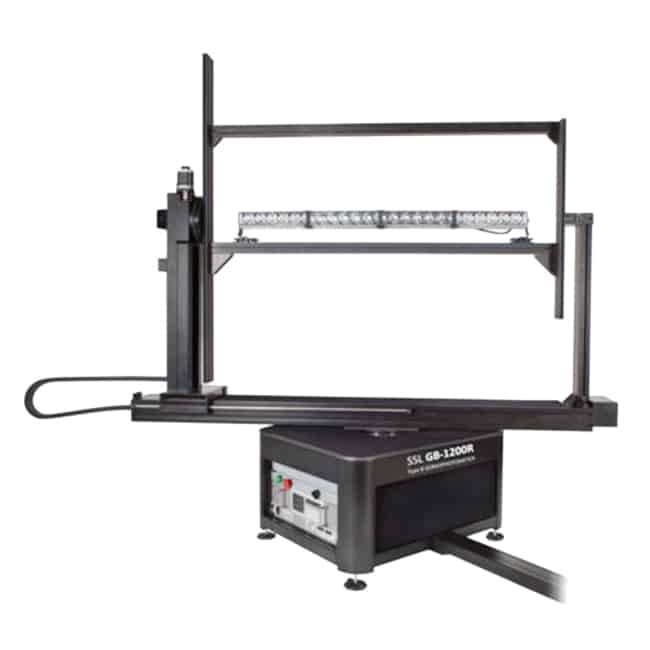
The SSL Resource LUMI B series type B motion goniophotometers tilt and rotate a lighting product about orthogonal horizontal and vertical axes. In type B motion, the device under test is tilted about a horizontal axis, which means that its direction of peak intensity (orientation) moves with respect to gravity during a scan. Typical applications for type B goniophotometers include the measurement of vehicle lighting (for example, automotive headlamps and marker/side lamps), as well as VMS signs and marine, airfield, traffic, train and bicycle lighting.
The LUMI goniophotometer platform can be supplied configured for either type B or type C motion. Furthermore, a customer may convert their system from type B to type C motion (and vice versa) using an optional accessory kit. This would be useful if measurements of both directional and architectural lighting products were required.
The LUMI family is offered in three models. The smallest, the LUMI 90.B, can accommodate samples that measure up to 60cm long by 50cm tall by 10cm deep. The intermediate LUMI 120.B is rated for samples measuring up to 160cm long by 80cm tall and 30cm deep. Lastly, the LUMI 180.B can handle lighting products that measure up to 100cm long by 100cm tall and 30cm deep. The goniometer motion stages feature an angular resolution of <0.01°.
Over and above the entry-level C-1 systems, LUMI goniophotometers offer additional features that enhance ease-of-use, increase productivity and promote application flexibility. Starting with the electronics rack, LUMI models integrate all system modules into one, compact 19-inch rack unit. The goniometer motion stage is mounted directly onto this cabinet for ease of transportation and enhanced stability. In addition to the two, standard motorised axes, LUMI systems can be configured with a motorised vertical arm and camera that automates the positioning of the device under test about the goniometer’s centre of rotation. The camera can also automatically determine the size of the luminous area of the light source. Lastly, you can add a motorised sample holder, making the job of mounting your sample to the goniometer frame much simpler and quicker. As an example, the two-handed linear sample holder allows you to mount a luminaire in less than 5 seconds.
Please note that a LUMI goniophotometer does not meet the requirements for burn position as stated in standards such as CIE S025 or IES LM 79-19. If you wish to comply with these standards, you can equip the LUMI system with the BPC (burn position corrector) option.
The recommended minimum dark room size for the LUMI 90.B is 1.1 x 1.1 x 10m, while for the LUMI 120.B this grows to 3.5 x 3.5 x 20m. For the LUMI 180.B, the dark room size should ideally be 2.7 x 2.7 x 17m. Please note that to satisfy the far-field condition for narrow angle beams, the photometer head may need to be placed at a greater distance.
The angular luminous intensity distribution is recorded as standard using the SSL LC-800 laboratory-grade photometer, equipped with a precision DIN class A photopic sensor head. The system can be equipped with tristimulus colorimeter sensors as an option if you also wish to measure the CIE chromaticity coordinates and correlated colour temperature (CCT) distribution of the lamp. The sensor is supplied with a stand and stray light tube.
 Up to four sensors can be operated as part of a LUMI goniophotometer system. A secondary photometer provides for measurements of low luminous intensities and for automated flicker measurements. An auxiliary camera can be used for automatic alignment of the device under test and to compute the luminous area. The camera can also record a reference photograph of the sample and compute the UGR glare rating of the luminaire. A spectroradiometer can record the CCT and CRI as a function of angle and also report spatial colour uniformity.
The SSL GPM software provides full control of the goniophotometer and records the luminous intensity distribution from the sample under test. Additional software features for type A/B goniometers include an analysis tool for road surface lighting, a horizontal ISOLUX chart (“bird’s eye” road view) and pass/fail reporting of luminous intensity and illuminance values at defined H, V angles according to various standards, including ICAO, CAP437, UNECE, SAE, FVMSS108 and FAA.
Included as standard are an alignment laser and a laser distance meter. Options include an auxiliary spectroradiometer, a flicker photometer and computer-controlled AC/DC power supplies. Also optional are the motorised vertical axis and camera alignment system and a motorised sample holder (4 types available as standard).
 Key Features
» Ideal for: directional railway and automotive lighting
» Goniometer type: 2-axis motorised, IES type B motion
» Maximum sample size: 1000 x 560mm (L x H)
» Maximum sample weight: 15kg
Overview
The SSL Resource AUTO 100 is a type B motion goniophotometer that tilts and rotates a lighting product about orthogonal horizontal and vertical axes. In type B motion, the device under test is tilted about a horizontal axis, which means that its direction of peak intensity (orientation) moves with respect to gravity during a scan. Typical applications for type B goniophotometers include the measurement of vehicle lighting (for example, automotive headlamps and marker/side lamps), as well as VMS signs and marine, airfield, traffic, train and bicycle lighting.
The AUTO 100 can accommodate samples that measure up to 1000mm long by 560mm tall and weigh up to 15kg. The goniometer motion stages feature an angular resolution of <0.01°. The recommended minimum dark room size is 1.7 x 1.7 x 11m, although please note that to comply with standards, the photometer head may need to be placed at a greater distance (for example, 25m for headlamp conformity testing per ECE regulations).
The angular luminous intensity distribution is recorded as standard using the SSL LC-800 laboratory-grade photometer, equipped with a precision photopic sensor head. The system can be equipped with tristimulus colorimeter sensors as an option if you also wish to measure the CIE chromaticity coordinates and correlated colour temperature (CCT) distribution of the lamp. The sensor is supplied with a stand and stray light tube.
The SSL GPM software provides full control of the goniophotometer and records the luminous intensity distribution from the sample under test. Additional software features for type A/B goniometers include an analysis tool for road surface lighting, a horizontal ISOLUX chart (“bird’s eye” road view) and pass/fail reporting of luminous intensity and illuminance values at defined H, V angles according to various standards, including ICAO, CAP437, UNECE, SAE, FVMSS108 and FAA.
Included as standard are an alignment laser, the MC-200-BT goniophotometer controller and two generic sample holders, the SSL SH-B.Linear and SH-B.Round. Options include an auxiliary spectroradiometer, a flicker photometer and computer-controlled AC/DC power supplies.
 Key Features
» Ideal for: automotive, maritime, railway and runway lighting as well as VMS traffic signals
» Goniometer type: 3-axis motorised, IES type A motion
» Maximum sample size: 1000 x 1000mm (L x H)
» Maximum sample weight: 50kg
Overview
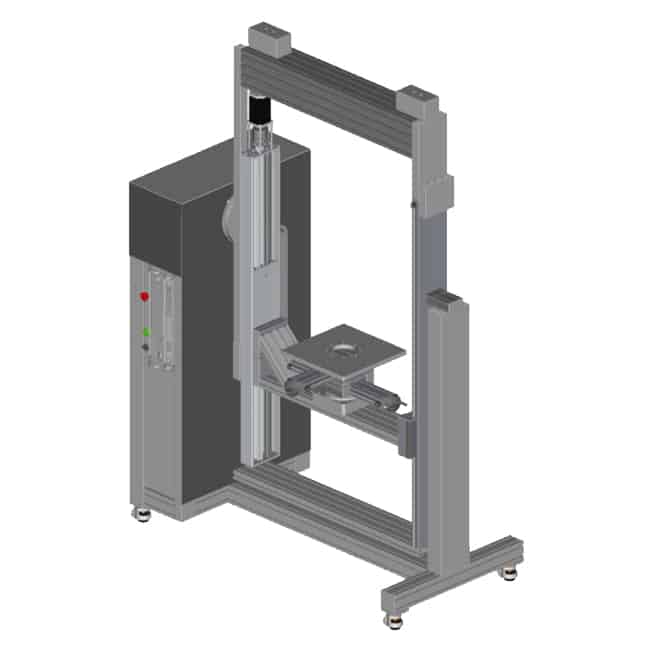
The SSL Resource AUTO 1000 is a type A motion goniophotometer that tilts and rotates a lighting product about orthogonal horizontal and vertical axes. In addition, the AUTO 1000 features a motorised Z-axis to correctly position the device under test vertically on the goniometer frame, while optional X & Y-axis manual positioning is available for the sample. Remote control of the motorised axes is available from your Android device via Bluetooth.
In type A motion, the device under test is tilted about a horizontal axis, which means that its direction of peak intensity (orientation) moves with respect to gravity during a scan. Typical applications for type A goniophotometers include the measurement of vehicle lighting (for example, automotive headlamps and marker/side lamps), as well as VMS signs and marine, airfield, traffic, train and bicycle lighting.
The AUTO 1000 can accommodate samples that measure up to 1000mm long by 1000mm tall (850mm with optional X/Y axis control) and weigh up to 50kg. The goniometer motion stages feature an angular resolution of <0.01°. The recommended minimum dark room size is 2.0 x 2.5 x 12-37m. Please note that to comply with standards, the photometer head may need to be placed at specific distances (for example, 25m for headlamp conformity testing per ECE regulations).
The angular luminous intensity distribution is recorded as standard using the SSL LC-800 laboratory-grade photometer, equipped with a precision DIN class A photopic sensor head. The system can be equipped with tristimulus colorimeter sensors as an option if you also wish to measure the CIE chromaticity coordinates and correlated colour temperature (CCT) distribution of the lamp. The sensor is supplied with a stand and with a stray light tube.
The SSL GPM software provides full control of the goniophotometer and records the luminous intensity distribution from the sample under test. Additional software features for type A/B goniometers include an analysis tool for road surface lighting, a horizontal ISOLUX chart (“bird’s eye” road view) and pass/fail reporting of luminous intensity and illuminance values at defined H, V angles according to various standards, including ICAO, CAP437, UNECE, SAE, FVMSS108 and FAA.
Included as standard are an alignment laser and the MC-200-BT goniophotometer controller. Options include the manual X/Y-axis positioning stage, an auxiliary spectroradiometer, a flicker photometer and computer-controlled AC/DC power supplies.
SSL Resource offer a range of precision, laboratory-grade photometers, colorimeters and spectroradiometers that can be deployed as part of a goniophotometer system or can be used independently. A photometer provides a wide dynamic range measurement of illuminance in lux, luminous intensity in candelas, and of total luminous flux in lumens (computed as the 2π or 4π integral of directional luminous intensity). A tristimulus colorimeter doubles as a photometer but adds the capability to measure CIE chromaticity coordinates and correlated colour temperature in Kelvin. A spectroradiometer is generally used as a secondary sensor in a goniophotometer system due to a more limited dynamic range but adds the ability to measure radiometric (UV and IR) light levels, photon flux readings for assessing horticultural lighting and colour rendering metrics.
 SSL LC-800.x Laboratory Photometer & Colorimeter – Brochure
The SSL LC-800.x is a precision, high speed photocurrent meter capable of accepting inputs from 1 to 4 sensors, with the “x” suffix denoting the number of channels chosen. The LC-800 can function both as a photometer when connected to a photopic sensor, or as a colorimeter when connected to three tristimulus XYZ response sensors. Please note that for the highest colorimetric accuracy, the LC-800 can be equipped with four tristimulus sensors, with the X (red) channel separated into XR (red) and XB (blue) channels. The LC-800 is compatible with both LH- and CH-series sensors.
With a dynamic range of 9 decades, the LC-800 is capable of recording both high intensity and low intensity light levels without the need to move the sensor whilst maintaining the required far-field test conditions. In comparison, a spectroradiometer may need to be moved closer to the light source to avoid signal to noise errors with low powered lighting or moved further away to avoid saturating the sensor with a high-powered source.
With a sampling bandwidth of up to 200kHz, the LC-800 can also function as a sensitive flicker meter, with the ability to record stroboscopic visual measure (SVM) flicker at >2kHz. This bandwidth also allows a goniophotometer system equipped with an LC-800 to measure “on the fly”, resulting in shorter scan times compared with more traditional “stop & go” type motion.
SSL L-40 Laboratory Photometer – Brochure
The SSL L-40 is a more economical alternative to the LC-800 for those who don’t need such a wide dynamic range. The L-40 is compatible with LH-series photopic sensors and with a sampling bandwidth of up to 100kHz, both photometric and flicker measurements are possible. The L-40 is available in two versions, with both the low light level and high light level versions (L-40.2) providing a dynamic range of over 4 decades.
SSL C-400 Laboratory Colorimeter – Brochure
The SSL C-400 is a three-channel colorimeter version of the L-40 photometer. The L-400 is compatible with the CH-series tristimulus sensors, and with a sampling bandwidth of up to 15kHz, photometric, colorimetric and flicker measurements are possible. The L-400 is available both as a low light level and as a high light level model (L-400.2) and provide a dynamic range of over 4 decades.
 SSL S-680 Laboratory Spectroradiometer – Brochure
The SSL S-680 is a compact, CCD array spectrometer that is usually chosen as a secondary sensor in a goniophotometer system given the more limited dynamic range it possesses than the LC-800 photometer. It provides the ability to measure radiometric (UV and IR irradiance) values as well as photon flux readings for assessing horticultural lighting and colour rendering metrics for architectural lighting. The S-680 is available in four versions that cover different ranges in the 250-1050nm wavelength range.
SSL S-80 Portable Spectroradiometer – Brochure
The SSL S-80 “SPEKTRI” is a portable array spectroradiometer that can be used as a secondary sensor as part of a goniophotometer system, or separately as a versatile light meter. The S-80 provides for spectral irradiance measurements from which photometric and colorimetric parameters are computed. As a secondary sensor in a goniophotometer system, the S-80 provides the ability to measure radiometric (UV and IR irradiance) values as well as photon flux readings for assessing horticultural lighting and colour rendering metrics for architectural lighting.
For field use, the S-80 is controlled via Bluetooth from your Android smart phone, while for laboratory applications, communication is via USB to a PC (Windows software is available as an extra cost option).
 The S-80 is sold in one of five application-specific configurations:
 SSL Resource Photometric & Colorimetric Sensors
When configuring your SSL goniophotometer system, you can choose from a range of photometric, colorimetric and radiometric response sensor heads. Each is designed for use with an SSL photocurrent meter (see: Meters tab). Note that the range and resolution of a particular sensor is influenced by the companion meter it is paired with.
A photopic response sensor provides a wide dynamic range measurement of illuminance in lux, luminous intensity in candelas, and of total luminous flux in lumens (computed as the 2π or 4π integral of directional luminous intensity). A tristimulus colorimetric sensor doubles as a photometer but adds the capability to measure CIE chromaticity coordinates and correlated colour temperature in Kelvin. A radiometric sensor provides for a near wavelength independent response over a defined spectral range for the measurement of infrared irradiance in Watts per square meter. A further range of radiometric sensors is designed for measuring the photosynthetic photon flux density (PPFD) from horticultural lighting products.
SSL LH Photopic Response Sensors
The LH photopic response sensors are silicon detectors combined with a filter that imparts a spectral match to the CIE V(λ) photopic observer function and calibrated for measurements of illuminance in lux. When used to measure axial luminous intensity as part of a goniophotometer system, a baffle tube is supplied to screen stray light. When measuring extended sources, a cosine diffuser is available for the 6.7mm sensor to properly scale the off-axis illuminance. With an f1′ of 3%, most sensors in the LH family satisfy the spectral matching requirements of DIN class A.
SSL LH PPFD Radiometric Response Sensors
The LH PPFD radiometric response sensors are silicon detectors combined with a radiometric filter that is calibrated for the measurement of photosynthetic photon flux density in units of μmols/m².s. These detectors are used to assess the performance of horticultural lighting products.
SSL LH Irradiance Sensors
The LH irradiance sensors are silicon detectors combined with a radiometric filter that is calibrated for the measurement of irradiance in units of W/m². These detectors are used to assess the performance of infrared lighting products.
SSL CH Tristimulus Colorimetric Response Sensors
The CH tristimulus response sensors comprise three or four collocated silicon sensors each matched to the CIE 1931 xyz tristimulus color matching functions. These detectors are calibrated for illuminance measurements in lux and add the capability to measure CIE chromaticity coordinates and correlated colour temperature (CCT) in Kelvin. The four channel sensors separate the CIE X tristimulus response into X-red and X-blue channels for improved colorimetric accuracy.
 SSL Resource Goniophotometer Software
Your SSL Resource goniophotometer system will be supplied with Windows software specific to the motion type(s) you have chosen, either type C or type A/B. You can either provide your own PC, or if you prefer, Pro-Lite will supply a pre-configured computer as part of the goniophotometer system.
Type C Goniophotometer Measurement Parameters
The type C goniophotometer system software will report the following parameters when used with the SSL LC-800 photometer:
The type C goniophotometer software provides a multitude of charting options. These include polar intensity diagrams for selected C-planes, dynamic cone illuminance diagrams, BUG (back/up/glare) diagrams and spatial illuminance modelling tools. For systems equipped with a colorimeter, the spatial colour uniformity (SDCM) is presented in a CIE chromaticity diagram. For systems equipped with a spectroradiometer, TM-30 colour rendering vector charts are produced.

The luminous intensity values can be exported as delimited text (XML format) or as standardised photometric data files in IES, LDT or TM-30 formats. A built-in convertor allows for files to be converted between the different formats, while an LDT editor allows for manipulation of files without recourse to third party software. For luminaires that shine up and down, the software has a utility for combining both the upwards and downwards facing measurement data into a single file. A beam symmetrisation tool simplifies the measurement of rotationally symmetric luminaires.
Type A/B Goniophotometer Measurement Parameters
SSL Resource AUTO 100 (type B) and AUTO 1000 (type A) goniophotometers, as well as the natively type C LAMP 30 or LUMI series model configured for type B motion (or supplied with a type C to type B conversion kit) are supplied with supplementary software that features pass/fail type reporting to various vehicle, transportation and avionics standards, including ICAO, CAP 437, ECE, FVMSS108, FAA and so on. Road illumination can be rendered as a “bird’s eye” plan view or as a 3D projection on the road surface in greyscale combined with a traversal plane at 50m in colour. Isolux charts can also be generated to render zones of constant illuminance.
The following options are available for your SSL Resource goniophotometer system.
Light Meter Options

Compliance with CIE S025 & IES LM-79-19: Burn Position Correction
Standards such as CIE S025 and IES LM-79-18 require that the device under test be mounted in its design orientation and not be tilted or rotated with respect to gravity during a goniometric scan. All SSL type C motion goniophotometers except for the DECO 27 mount the device under test (DUT) in a vertical plane, such that the optical axis is horizontal. While the lamp does not tilt with respect to gravity during a scan, it will rotate about its own horizontal (azimuth) axis. Given that most architectural light fittings tend to be ceiling mounted and shine vertically down, it can be desirable to mount the DUT in the same (vertical, base-up) orientation.
To this end, we offer the SSL-ALI Absolute Lumen Integrator. This accessory attaches to the C-plane motor of the host goniometer system to mount the DUT in a vertical-down (base up) orientation. It is designed to mount architectural or decorative light fittings with relatively small luminous areas. In the event that you cannot mount the DUT in its intended orientation, we offer the SSL-BPC Burn Position Corrector accessory (shown right fitted to a LUMI 90). This device also attaches to the C-plane motor of the host goniometer and allows the operator to measure the difference in light output from the DUT in its design orientation compared to that in which it is mounted onto the goniophotometer. The goniophotometer software will then compute a correction factor which it will then automatically apply to subsequent measurements of that product.
The DECO 27 goniophotometer is also a type C motion model, however unlike the other models, the DUT is mounted in a vertical-down orientation. As such, the DECO model fully complies with the fixed burn position requirements of CIE S025 and IES LM79-19 without recourse to either the ALI or BPC accessory options.
Alignment Camera
The SSL IMG-2 is a 2.3 Megapixel USB 3.0 auxiliary alignment camera that is available as an option in SSL LUMI-series goniophotometers. In addition to the two, standard motorised axes, LUMI systems can be configured with a motorised vertical arm and camera that automates the positioning of the device under test about the goniometer’s centre of rotation. The camera can also automatically determine the size of the luminous area of the light source. Lastly, you can add a motorised sample holder, making the job of mounting your sample to the goniometer frame much simpler and quicker.
Packaging Options
Stray Light Control
Stray light should be minimised in all photometric laboratories. All SSL goniophotometer systems are supplied with a photometer and sensor that is equipped with a stray light tube. This limits the field-of-view of the sensor to just beyond the lit area of the DUT as it moves on the goniometer frame. To further reduce stray light errors, we offer the SSL BLACK low reflectance fabric material that can be placed directly behind the goniophotometer. The combination of stray light tube and black material behind the goniometer frame allows the use of overhead lighting during goniometric scans.
Sample Holders
A wide range of standard sample holders is available to simplify the mounting of your lighting product to the SSL goniometer frame. Choose from holders for linear fittings, panel lights, downlighters, streetlights, recessed fittings and flood/high bay lights. Customised holders are also available upon request.
 Motion Conversion Kits
SSL LAMP 30 as well as LUMI series type C goniophotometers can be fitted with an accessory kit to convert their motion to type B for the measurement of directional light sources. The user-installed kit includes mechanical adaptors and a type B software bolt-on. Similarly, a LAMP 30.B or LUMI series goniometer that is factory configured for type B motion can be converted to type C motion with an accessory kit. The type B to type A kit is shown in the image to the right.
Computer
The SSL-PC option is a Windows computer that is supplied preconfigured and with software preinstalled for the goniophotometer system. This simplifies the procurement of a suitable computer, saving time and helping to ensure that your goniometer system is up and running as quickly as possible.
Datasheets & Brochures
Technical Information
Videos