By Russell Bailey, May 2024
Abstract
The solar reflectance and heat retention properties of materials are key factors that lead to increased temperatures in urban compared with rural environments. The metric developed to assess the performance of building materials is called the Solar Reflectance Index (SRI).
What is the Heat Island Effect?
The heat island effect is a description of a number of factors within urban environments, especially in cities, that cause those areas to maintain higher temperatures compared to surrounding rural areas. This effect is driven mostly by factors associated with urbanisation and human activities. Building materials, limited green spaces and energy used for heating or cooling all contribute to the heat island effect.
The heat island effect causes an appreciable difference in temperature, with the most current models finding that London is ~4.5ºC warmer than surrounding rural areas. In smaller towns and cities, this variation is 1-3ºC.
Figure 1. Urban heat island profile
Elevated urban temperatures are concerning because of the effect on human health, wildlife, and the environment in general. It exacerbates heat waves in urban areas making them more severe and adding to excess deaths caused by heatstroke and to those with chronic conditions. Similarly, wildlife suffers increased mortality in these heatwaves. Finally, due to increased temperatures, homes and businesses are more likely to require air conditioning which means increased energy usage that adds to the production of CO2. While air conditioning is less common in the UK, in other parts of the world such as the USA, air conditioning is widely used. Globally, it is estimated that air conditioning accounts for 10% of all electricity used.
Standards for building materials and green spaces have been introduced in some parts of the USA and Europe and are beginning to be discussed for the UK. Currently, there isn’t national legislation in the UK, but planning rules have been introduced in some regions and are starting to be required. These add requirements on the building materials used and on green spaces to try to mitigate the heat island effect.
What Does This Mean for Manufacturers of Building Materials?
Building materials absorb heat during the day and re-emit the heat at night once the sun sets. This causes urban areas to retain heat in the evenings and maintain this higher average temperature. This effect can be mitigated using materials that reflect sunlight (we refer to the solar reflectance) and don’t retain the heat (have a high emittance). Buildings with low solar reflectance will absorb energy and if that is combined with a low emittance the heat is retained in the building and emitted at night. The Solar Reflectance Index (SRI) was defined as a way of determining if a material reduces this absorbing-and-retaining heat effect. SRI is a measure of both the solar reflectance and the emittance of a material and is designed to indicate how warm that surface will get in sunlight.
SRI is defined by the US standards organization ASTM International in ASTM E 1980 – Standard Practice for Calculating Solar Reflectance Index of Horizontal and Low-Sloped Opaque Surfaces.
The solar reflectance index is calculated as follows: ![]()
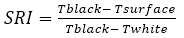
The emittance and the solar reflectance are needed to determine the Tsurface value that are required to calculate SRI.
While the SRI of a material is described as having a value of 0 – 100, it is possible to have negative values or values greater than 100 due to the way the black and white surfaces are defined. The standard black surface is defined as a surface with a solar reflectance of 0.05 and an emittance of 0.90, which would lead to an SRI of 0. The standard white surface is defined as a surface with a solar reflectance of 0.80 and emittance of 0.90 and this would have an SRI of 100.
The most advanced standard currently in use is the U.S. Green Building Council’s Leadership in Energy and Environmental Design (LEED) 2009 rating system. This is the world’s most widely used green building rating system. While LEED is a voluntary system, some authorities require adherence or offer some sort of reward/credit to those that adhere.
Generally, SRI is an important metric in assessing the materials used for roofing, paving and roads as these are the most exposed to direct sunlight. In the UK, manufacturers of paving, roofing and other building materials may be asked about the SRI of their materials. More environmentally aware councils are including heat island mitigation in their planning requirements and recent Environmental Audit Committee reports have raised the need for inclusion of heat island mitigation in national legislation.
Figure 2. Solar Reflectance Index (SRI)
How Solar Reflectance Index is Measured
To calculate SRI, manufacturers of building materials need to measure the solar reflectance factor as well as the thermal emittance of that material. The calculations to determine SRI based upon these measurements are found in the ASTM E 1980 standard. Solar reflectance is a measurement of the total solar flux reflected by a surface. This is the integral of the reflectance between 300nm in the ultraviolet and 2500nm in the near infrared and is expressed as a reflectance factor on a scale from 0 to 1.
There are several ways to measure solar reflectance factor. One type of instrument is a benchtop spectrophotometer with an integrating sphere, such as the Perkin Elmer 950 that we use in our laboratory at SphereOptics in Germany (Reflectance & Transmittance Testing Services). This measures the spectral hemispherical reflectance in 1nm steps in the 300 – 2500nm region and from that you can calculate the integrated reflectance factor. Another way to measure this is to use a handheld reflectometer such as the 410-Solar (410-Solar reflectometer) from Surface Optics Corporation. This measures the integrated hemispherical reflectance in each of seven bands between 330nm – 2500nm and calculates the solar reflectance factor.
The emittance of a surface is its effectiveness in emitting energy as thermal radiation. It is the ratio of the thermal radiation from a surface to the radiation from an ideal black body surface at the same temperature given by the Stefan–Boltzmann law. The ratio varies from 0 to 1. A blackbody radiator is a material that absorbs all infrared radiation incident on the surface and reemits it in equilibrium with the external temperature. A blackbody radiator inherently has an emittance of 1.
As with solar reflectance factor measurements, emittance can be measured in one of two ways. It can be determined using a benchtop FTIR spectrometer which measures the spectral reflectance and calculates the emittance. Alternatively, you can use a handheld emissometer such as the ET-100 (ET-100 emissometer) from Surface Optics Corporation. This works in a similar way to the 410-Solar and measures reflectance in 6 spectral bands in the 1.5 – 21µm range. From this, the emittance is calculated.
In general, the benchtop measurement methods are more accurate but this limits the measurement to a laboratory environment on sample pieces. Using a portable reflectometer / emissometer allows measurements to be performed much more quickly and most importantly enables measurements to be performed in-situ. This enables validation of laboratory measurements at a customer’s site.
Figure 3 . The instruments to measure a Solar Reflectance Index.
Pro-Lite's Products & Services for Measuring SRI
Pro-Lite offers measurement services, along with rental and purchase of Surface Optics reflectometers and emissometers. 
Portable Surface Optics Reflectometers and Emissometers


