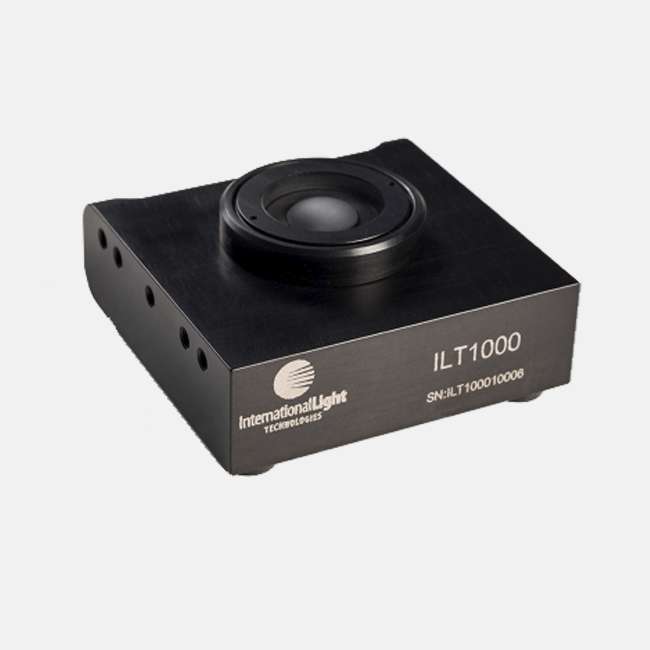
The ILT 1000 is a research-grade, datalogging light meter that can be configured for use as both a radiometer or as a photometer. The ILT 1000 is ideal for those applications in process control – and elsewhere – where you need to track the level of light over time. On-board data storage allows continuous monitoring at user-specified sampling rates using “set and forget” datalogging. The ILT 1000 is available in 6 standard models, each of which is preconfigured for a particular type of measurement in the range from 200 to 1700nm.
ILT 1000 Datalogging Light Meter Overview, Key Features & Specifications
The ILT 1000 is a research-grade, datalogging light meter that can be configured for use as both a radiometer or as a photometer. The ILT 1000 is ideal for those applications in process control – and elsewhere – where you need to track the level of light over time. On-board data storage allows continuous monitoring at user-specified sampling rates using “set and forget” datalogging. The ILT 1000 is available in 6 standard models, each of which is preconfigured for a particular type of measurement in the range from 200 to 1700nm.
The ILT 1000 can easily accommodate most solid-state detectors, 1/2” and 1” optical filters and a vast selection of input optics. The ILT 1000 can measure over 6 decades of light and provides a direct readout in W, W/cm2, lux, fc, lumens, cd/m2, cd, W/sr, W/sr/cm2 and more.
The ILT 1000 is available with the following photodetector options:
The ILT 1000 takes advantage of readily available, cost effective, wireless devices and provides ISO/IEC 17025:2017 accredited & NIST-traceable UV, VIS & IR light measurements. Wireless configurations provide users with the necessary flexibility and portability required for measurements in locations where cables are impractical. The ILT 1000 uses a standard USB interface for power and communication and works with most wireless networks.
The ILT 1000 comes with a complementary LabVIEW DLL sample code, an extensive API and ILT’s DataLight II light measurement and data collection software.
Applications
Typical applications for the ILT 100 include UV monitoring in the food and beverage industries, as well as drinking and pool water, HVAC, semiconductor, pharmaceuticals, cosmetics, and wastewater disinfection. Other application areas include process monitoring, curing, plant photobiology and thin film deposition.
ILT 1000 Key Features
ILT 1000 Input Optics
A wide range of interchangeable sensors, input optics, filters and other accessories is available that allows the user to configure their meter as either a radiometer or as a photometer for their preferred measurement.
The input optics attached to the photodetector define the type of measurements that can be made. There are four measurement types that you can make with your light meter: the total radiant flux (Watt); the flux per unit area received, called the irradiance (W/m2); the flux emitted per unit solid angle, called the radiant intensity (W/sr); and the flux emitted per unit area per unit solid angle, called the radiance (W/sr.m2). For photometric measurements, the equivalent parameters are luminous flux (lumen), illuminance (lumen/m2 = lux), luminous intensity (lumen/sr = candela) and luminance (cd/m2).
Type | Model | Description | Comment |
Diffuser | PD | Polycarbonate domed diffuser for VIS applications, 400 -700nm, 42mm OD | |
Diffuser | W | Quartz (1.024″ dia) wide-eye diffuser with internal dome, 200-2100nm, 42mm OD | |
Diffuser | WU | W diffuser with sealant and o-rings to allow submersion in liquids. 42mm diameter OD | |
Diffuser | TD | Teflon (21.5mm dia) dome diffuser, 200-700nm, 42mm OD | |
Diffuser | QT | Teflon (0.43” dia) diffuser with protective quartz window, 200-700nm, 42mm OD | |
Diffuser | QT-#mm | QT diffuser with aperture to measure smaller light spots. Available with 1, 3, 5 or 7mm apertures, 200-700nm | |
Diffuser | A313 | Quartz (0.43″ dia) flat multi-layer diffuser, 200-2100nm, 42mm OD | |
Diffuser | A313-#mm | A313 diffuser with aperture to measure smaller light spots. Available with 1,3,5 or 7 mm apertures, 200-2100 nm | |
Diffuser | T | Teflon (0.5″ dia) diffuser in threaded filter ring. With mating threads to allow add. optical components to attach. 42mm OD | |
Diffuser | RAA4 | Right angle adapter/diffuser (0.27″ dia) with mini integrating sphere, 0.61″ dia x 0.44″ tall | Designed for use with SMA-905 fibre optics |
Diffuser | RAA4X | Right angle adapter/diffuser (0.27” dia) with x10 attenuation, mini integrating sphere, 0.61” dia by 0.44” tall | Designed for use with SMA-905 fibre optics |
Diffuser | RAA5X | Mini right angle adapter/diffuser (0.25″ dia) with internal integrating sphere, 0.46 x 0.47 x 0.84″ | Designed for use with SMA-905 fibre optics |
Diffuser | A2 | Silica chips in a filter ring to be combined with W or WU for use on fiber optics. Requires MPS2354P2XD to connect to fibre | Designed for use with SMA-905 fibre optics |
Diffuser | W5E | Miniature cosine correcting diffuser with 6.35mm OD and ~10.92mm length. Threads directly onto SMA905 fibre | |
Laser Power Adaptor | HNK15 | Narrow beam adapter, eliminates alignment errors. 15mm opening | Used for testing small spots of light and or collimated beams |
Laser Power Adaptor | K15 | 15mm aperture and targeting aid | Used for testing small spots of light and or collimated beams |
Laser Power Adaptor | K9 | 9mm aperture and targeting aid | Used for testing small spots of light and or collimated beams |
Fibre Optic | FFO600SC | 1m 600µm solid core, low solar, patchcord, Kevlar jacket | To connect input optics to a sensor via an SMA patchcord |
Fibre Optic | FFO600FCPC | 1m 600µm solid core, low solar, patchcord, Kevlar jacket, FCPC to SMA-905 | To connect input optics to a sensor via an SMA patchcord |
Fibre Optic | FFO600SCW-3 | 3m 600µm solid core, patchcord, Kevlar jacket, submersible | To connect input optics to a sensor via an SMA patchcord |
Fibre Optic | FFOSMA2UV1000 | To connect input optics to a sensor via an SMA patchcord | |
Fibre Optic | FFO400UVIR | 1m 400µm, patchcord, SMA905, BX, 250-2500nm | To connect input optics to a sensor via an SMA patchcord |
Fibre Optic | FFO2501 |
| To connect input optics to a sensor via an SMA patchcord |
Fibre Optic | FFO12-S | Solid tubing, rated 300 deg C, patchcord, rigid, 12″ long | To connect input optics to a sensor via an SMA patchcord |
Fibre Optic | FFO18-S | Solid tubing, rated 300 deg C, patchcord, rigid, 18″ long | To connect input optics to a sensor via an SMA patchcord |
Fibre Optic | P11-2 | Fiber, 600 micron LSHOH, 1.97″ | To connect input optics to a sensor via an SMA patchcord |
Fibre Optic | P11-4 | Fiber, 600 micron LSHOH, 3.97″ | To connect input optics to a sensor via an SMA patchcord |
Fibre Optic | PIN4 | Contact luminance probe, fibre optic light guide | Requires P6/SMA adapter |
Filter Ring | A310 | Filter ring, mounts filters 25mm dia. upto 7mm thick, with 1 ¼”-24 threads | |
Filter Ring | A311 | Filter ring, mounts filters 25mm dia. upto 4mm thick, with 1 ¼”-24 threads | |
Filter Ring | MPS235600XD | Filter ring, mounts filters 12.7mm dia. up to 4mm thick, with 1 ¼”-24 threads | |
Filter Ring | MPS235500XD | Filter ring, mounts filters 12.7mm dia. up to 7mm thick, with 1 ¼”-24 threads | |
Right Angle Probe | RAMP12 | High temperature right angle probe, up to 300°C | Requires P6/SMA adapter |
Right Angle Probe | RAMP18 | High temperature right angle probe, up to 300°C | Requires P6/SMA adapter |
Hood | H | Hood, internally baffled to reduce stray light and field of view. Accepts std input optics & filters | Best for distance 25′ or less |
Hood | H2 | Hood, occlusion, with internal surface painted flat black to minimise internal reflections | For beam candela measurement on small light sources |
Lens | L30-1 | Lens, for effective intensity of flash sources at a distance greater than 25 feet | |
Lens | R | Lens, radiance/luminance, 1.5° FOV | |
Lens | R1.7 | Lens, radiance/luminance, 1.7mrad | |
Lens | R11 | Lens, radiance/luminance, 11.0mrad | |
Lens | R2 | Lens, radiance/luminance, 2.0° FOV | Designed for use with SMA-905 fibre optics |
Lens | R3 | Lens, radiance/luminance, small spot at fixed 500mm working distance | Designed for use with SMA-905 fibre optics |
Adaptor | P2 | Adaptor, 4.3mm ID | |
Adaptor | P6 | Adaptor, 12.5mm ID | |
Adaptor | P6/SMA | Adaptor, SMA-905 | Designed for use with SMA-905 fibre optics |
Aperture | SHM30727P## | Detector aperture for irradiance/illuminance measurements. Sizes (##) 1.0, 2.0, 3.0, 3.2, 4.3, 5.0 & 7.0mm dia. | |
Integrating Sphere | INS50 | Integrating sphere, 2″ dia, 0.276″ input port, SMA-905 adaptor to attach fibre | Designed for use with SMA-905 fibre optics |
Integrating Sphere | INS125 | Integrating sphere, 5″ dia, 3 ports (2 x 20mm, 1 x 40mm) |
ILT 1000 Filters
A wide range of interchangeable sensors, input optics, filters and other accessories is available that allows the user to configure their meter as either a radiometer or as a photometer for their preferred measurement.
A photodetector would typically be fitted with an optical filter which modifies the inherent spectral response of the sensor. For a radiometer to measure the amount of monochromatic light, you only need to know the calibrated spectral response of the photodiode at the relevant wavelengths. If the light source is anything other than monochromatic (which is the case for all light sources except lasers), a radiometer with bare photodiode cannot yield absolute radiometric measurements. A “radiometric” filter can be fitted to the photodiode that normalises the response over a limited wavelength range, typically ±10% from 450-950nm, which provides a partial solution.
A radiometer can also be equipped with a filter that limits or adapts the spectral response and these are typically used in safety or medical applications where certain wavelengths are more dangerous or more efficacious than others. Examples of this are measuring the safety of UVC light sources, measuring the erythemal effectiveness of a UVB source and measuring blue phototherapy lights used for the treatment of bilirubin (jaundice in new-borns).
A photometer is similar to a radiometer, but the photodiode is equipped with a special filter that modifies the spectral sensitivity of the detector/filter combination so as to match as closely as possible that of the human vision system, defined at the CIE spectral luminous efficiency for photopic vision (“photopic” response). The photopic response of the human eye strongly favours green coloured light, with blue and red light being perceived as less intense. Thus, a photopic sensor ranks the brightness of light sources in close agreement to how the human vision system would perceive them.
Mounted in threaded (1/4-24 thread) black anodized rings, all filters may be repeatably interchanged on any SED, SEL, and SHD detector. Unmounted filters and empty filter rings are also available.
Filter Type | Purpose | Description |
A | Photoresist filter | Provides an ‘A’ response (320-475nm) with silicon detectors |
ACT5 | Actinic germicidal filter | Provides an expanded actinic response or effective germicidal/bactericidal response when used with SED (SEL) 240 detector; also gives UV actinic hazard response curve per ACGIH |
T2ACT5 | Actinic germicidal filter / diffuser | Compries ACT5 actinic filter with T2X cosine diffuser |
B | Photoresist filter | Provides a ‘B’ response (326-401nm) with silicon detectors |
BAS | Bilirubin action spectrum filter | A blue light filter that imparts a Bilirubin action spectrum onto a silicon detector |
FUVC | Far UV filter | An interference filter with centre wavelength at 230nm, used to block longer wavelengths for testing excimer 222nm UVGI lamps |
F | Flat response filter | A “radiometric” filter that imparts a nominally flat spectral response when used with a silicon detector |
HMR-1 | Hot mirror | An IR-rejecting hot mirror, can be combined with the F filter for a flatter VIS response |
NS185 | Narrowband UV filter | An interference filter with centre wavelength of 185nm |
NSXXX | Narrowband UV filter | An interference filter with bandpass of 10nm and centre wavelengths of 254, 280, 313, 335, 350 & 365nm |
NSXXX | Custom narrowband filter | An interference filter with custom centre wavelengths in UV, VIS & NWIR bands |
NDFSS102 | Neutral density filter set | A set of UV-IR attenuating filters mounted to fit SED (also: SEL/SHD/SL) detectors. QNDS1, QNDS2 and QNDS3 included |
PAR-1 | Photosynthetically active radiation filter | A filter tailored to be combined with silicon detectors. Combined quantum response is spectrally flat in the visible range. |
QNDS1 | Neutral density filter | Quartz filter with 10 times attenuation (10% transmittance) |
QNDS2 | Neutral density filter | Quartz filter with 100 times attenuation (1% transmittance) |
QNDS3 | Neutral density filter | Quartz filter with 1000 times attenuation (0.1% transmittance) |
SCSXXX | Sharp cut-off filter | Glass, longwave-pass filters. 60% transmittance. Cut-off wavelengths available are 280, 365, 395, 440, 465, 490, 520, 530, 545, 590, 605, 622, 650, 695, 740, 780, 810 & 830nm |
BLUE | Blue hazard filter | Filter mounted for use with silicon detectors |
TFRD | Far red colour filter | Filter mounted for use with silicon detectors |
TRED | Red colour filter | Filter mounted for use with silicon detectors |
TLS312 | Narrowband UVB filter | Narrowband filter for use with GaAsP detectors, for TL-01 lamp measurement |
UVA | Phototherapy filter | A filter, when combined with a silicon detector, produces a UVA response from 315 to 390nm (10% transmittance) |
UVB-1 | Phototherapy filter | A filter, when combined with a solar blind vacuum photodiode, produces a response from 265 to 332nm |
UVB-2 | Phototherapy filter | A filter set that includes both shortwave-pass and longwave-pass filters to block UVC and UVA. Passes light from 280-310nm |
UVF | Flat response UV filter | A filter that imparts a flat response onto the 005 series UV-Visible GaAsP detector over a range of ~350-405nm (full range 275-450nm) |
WBSXXX | Wideband filter | Mounted glass filters with center wavelength at XXXnm. Note that many WBS filters cannot be used with silicon sensors due to a secondary response in the IR, so they are typically sold with the SED (SEL)005. Centre wavelengths available are 320, 350, 375, 400, 405, 440, 460, 465, 480 & 520nm |
Y4 | Photopic filter | A filter, when combined with a silicon detector, matches the CIE standard photopic observer function. F1′ of 1.6% when used with SED033 and SED100 detectors |
ZCIE | Scotopic filter | A filter, when combined with a silicon detector, matches the CIE standard scotopic observer function |
ZPM | Scotopic filter | A filter, when combined with the SCM068-1 PMT, matches the CIE standard scotopic observer function |
The ILT 1000 is a light meter that can be user-configured as both a radiometer and a photometer. Other types of light meter are colorimeters, spectrometers and spectroradiometers, which all measure the amount of light, but they operate in fundamentally different ways and have advantages and disadvantages.
Radiometers, Photometers & Colorimeters
Radiometers and photometers consist of a photodetector, an electrical readout and a calibration. The spectral response of a photodiode varies with the wavelength of the incident radiation. This means that 1 W/m2 of irradiance at 350nm in the UV will produce a different electrical current compared to 1 W/m2 of red light at 650nm.
The photodetector would typically be fitted with an optical filter which modifies the inherent spectral response of the sensor. For a radiometer to measure the amount of monochromatic light, you only need to know the calibrated spectral response of the photodiode at the relevant wavelengths. If the light source is anything other than monochromatic (which is the case for all light sources except lasers), a radiometer with bare photodiode cannot yield absolute radiometric measurements. A “radiometric” filter can be fitted to the photodiode that normalises the response over a limited wavelength range, typically ±10% from 450-950nm, which provides a partial solution.
A radiometer can also be equipped with a filter that limits or adapts the spectral response and these are typically used in safety or medical applications where certain wavelengths are more dangerous or more efficacious than others. Examples of this are measuring the safety of UVC light sources, measuring the erythemal effectiveness of a UVB source and measuring blue phototherapy lights used for the treatment of bilirubin (jaundice in new-borns).
A photometer is similar to a radiometer, but the photodiode is equipped with a special filter that modifies the spectral sensitivity of the detector/filter combination so as to match as closely as possible that of the human vision system, defined at the CIE spectral luminous efficiency for photopic vision (“photopic” response). The photopic response of the human eye strongly favours green coloured light, with blue and red light being perceived as less intense. Thus, a photopic sensor ranks the brightness of light sources in close agreement to how the human vision system would perceive them.
A colorimeter is a type of photometer that combines three of four photodiodes each with a filter that closely matches the tristimulus response of the eye (the XYZ or XRXBYZ tristimulus colour matching functions). A colorimeter measures the emitted colour of the light source under test, and reports this as tristimulus values, as CIE chromaticity coordinates and as correlated colour temperature (CCT) values or as a dominant wavelength. The Y filter of a colorimeter is the same as the photopic filter in a photometer, hence a “tristimulus” colorimeter can also function as a photometer.
Spectrometers & Spectroradiometers
Whereas radiometers, photometers and colorimeters employ photodiodes with special filters, a spectroradiometer measures what is called the spectral power of the light source, which is the amount of light at each wavelength. The spectral response of the spectroradiometer is calibrated at each wavelength, which therefore avoids the error that arises from measuring the irradiance of broadband light sources with unfiltered radiometers (or even radiometers equipped with normalising filters).
From the measured spectral power, the desired radiometric, photometric or colorimetric metrics can be calculated. A spectroradiometer avoids the potentially significant errors that filtered photometers and colorimeters suffer from where the spectral response of the filtered sensor doesn’t exactly match that of the target observer, for example the photopic response of the eye. This is an important consideration; a high-quality photometer may have a average spectral mismatch (the f1’ factor) to the photopic observer of 5% over the 380-780nm visible light band, but can still yield errors of 50% or more when used to measure blue or red LEDs, for example.
A spectroradiometer is the name given to a spectrometer that is equipped with appropriate collection optics and an absolute calibration. A spectrometer is an optical instrument that employs a diffraction grating that physically separates the incident light into its component wavelengths. Each discrete wavelength is imaged onto an array photodetector, which allows for the recording of a spectral power distribution instantaneously.
Datasheet: ILT 1000 Laboratory Light Meter Datasheet
ILT Light Meter Range: ILT Light Meter Comparison Table
Manual: ILT 5000 Light Meter Manual
Thanks for getting in touch!
Our team will respond as soon as possible.
Product Enquiry
Please complete all fields