
The following target types are offered as standard. Enquiries for custom visible and custom IR targets are welcomed fro help in defining your preferred target specifications.
 | Four-Bar Targets4-Bar, 7:1 aspect ratio targets are used to perform Minimum Resolvable Temperature Difference (MRTD) measurements. This test is a measure of overall system performance, and is the minimum differential temperature required for an observer to just detect a target of a specific spatial frequency. A set of targets with various spatial frequencies is used to measure MRTD as a function of spatial frequency. |
 | Multiple Four-Bar TargetsConstructing a target with several 4-Bar targets on a single target plate is a cost-effective means of multiple spatial frequency MRTD testing. Applications include production testing, GO/NO-GO testers, and quick performance checks. NOTE: Measured MRTD can vary with the location of the target due to the cos4(ϑ) effect. Additionally the presence of multiple targets may affect the objectivity of the observer. |
 | Window TargetsVarious window targets are used for tests such as Minimum Detectable Temperature (MDT), Signal Transfer Function (SiTF), Aperiodic Transfer Function (ATF), ringing, and low-frequency response. Window targets can be made with one edge on centre, for Modulation Transfer Function (MTF) testing. Window targets can be manufactured in a wide range of sizes and aspect ratios. |
 | Pinhole TargetsPinhole targets are typically used for tests such as Minimum Detectable Temperature (MDT), alignment, and boresight, or as a limiting aperture in front of a source of radiation. |
 | Alignment TargetsAlignment targets are useful in boresighting applications, collimator alignment, and focusing. With an SBIR target projector system incorporating a target alignment light, these operations are greatly simplified. Pinholes, as well as pinhole-and-cross combinations are typically used; others are available upon request. |
 | Edge/Slit TargetsAn edge/slit target (sometimes referred to as a half-moon target) is used for MTF testing. The unit under test images the slit, and a line of video is stripped out. MTF is obtained from the Fourier transform of the video data, corrected by the finite slit width response. By measuring the output as a function of variable slit width, the slit response function (SRF) is obtained. The SRF provides the imager Instantaneous Field of View (IFOV). |
 | Interlace TargetsAn interlace target is used to detect poor interlace mirror adjustment, as well as to identify strapped or dead channels. These faults are seen as deviations from the ideal smooth diagonal line. |
 | Three-Temperature TargetsBoth emissive and reflective coatings can be incorporated into a single target. When this type of target is used with an SBIR target projectors, a total of three radiance values can be projected at the same time. Applications for these targets include plume or vehicle signature simulations. |
 | Frequency Sweep TargetsTypical applications for frequency sweep targets include setting system focus, GO/NO-GO screening, Contrast Transfer Function (CTF) measurement, and environmental testing. The frequency sweep target can also be used to evaluate image processing algorithms, such as line-to-line interpolation. Targets can be made with either a linear or logarithmic sweep. |
 | Correlation TargetsSBIR manufactures the Standard Correlation Target (patent pending), as well as many other targets for evaluating signal processing, machine vision, and tracking algorithms. The Standard Correlation Target is a target of known complexity and detail, specified by the number of features and the statistical distribution of feature size. This target simulates Closely Spaced Objects (CSOs) for Infrared Search and Track (IRST) applications. |
 | Distortion TargetsOne way to measure geometric distortion is by presenting a uniform array of precisely-located fiducial marks to the device under test. These marks are then either measured on the display, or compared to a regular array of lines generated by a signal generator. A regular array of pinholes is excellent for this application. |
 | Abingdon TargetsThis target is used to evaluate the speed and accuracy of image processing algorithms. The task is to find the medial axis of the cross. The area of the cross and its intensity are equated to the area and intensity of the object it is meant to simulate. It is a useful measurement tool to indicate how quickly the algorithm can find targets in the real world. |
 | Grey Scale TargetsGrey scale targets can be manufactured in a variety of step size functions and gray levels. The step functions can be linear or logarithmic, from zero to 100% transmission. Grey scales are used to measure linearity and dynamic range in a single operation. Note: these targets are all custom-made and require all input from a customer specification drawing. |
 | Scene TargetsScene targets consist of a sub-pixel dot pattern deposited onto an IR transmitting substrate. SBIR produces a variety of scene targets with varying levels of resolution and greyscale. Scene targets are typically used for mission simulation and training. Note: these targets are all custom-made and require all input from a customer specification drawing. |
 | USAF1951 Resolution TargetChrome on glass, 100% contrast resolution target for visible sensor system testing. |
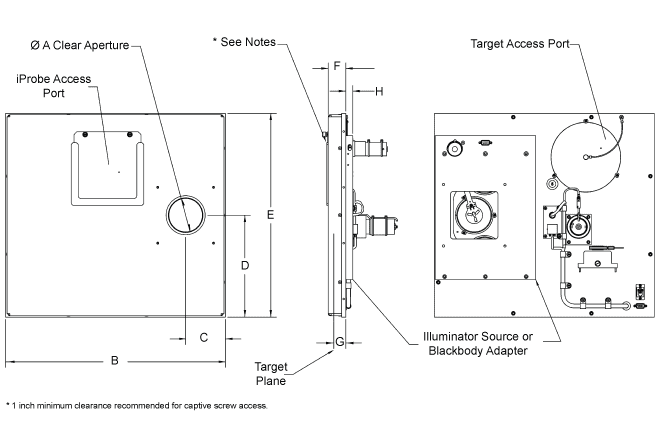
| Model # | # of Positions | A in. (cm) | B in. (cm) | C in. (cm) | D in. (cm) | E in. (cm) | F in. (cm) | G in. (cm) | H in. (cm) | Blackbody Model # | Illuminator Source |
| 312i | 12 | 2.00 (5.08) | 13.62 (34.59) | 2.70 (6.86) | 6.25 (15.88) | 12.50 (31.75) | 1.50 (3.81) | 0.98 (2.49) | 0.63 (1.60) | DB-04 | 330/331/335 |
| 315i | 6 | 5.00 (12.70) | 19.69 (50.01) | 4.56 (11.58) | 9.12 (23.16) | 18.25 (46.36) | 1.58 (4.01) | 0.98 (2.49) | 0.63 (1.60) | DB-04 | 331/333 |
| 316i | 12 | 3.00 (7.62) | 19.69 (50.01) | 3.56 (9.04) | 9.12 (23.16) | 18.25 (46.36) | 1.58 (4.01) | 0.98 (2.49) | 0.63 (1.60) | DB-04 | 331/333 |
| 317i | 16 | 3.00 (7.62) | 24.30 (61.72) | 3.56 (9.04) | 11.50 (29.21) | 23 (58.42) | 1.58 (4.01) | 0.98 (2.49) | 0.63 (1.60) | DB-04 | 331/333 |
| 318i | 12 or 36 | 3.00, 1.00 (7.62, 2.54) | 24.3 (61.72) | 3.56 (9.04) | 11.50 (29.21) | 23 (58.42) | 1.58 (4.01) | 0.98 (2.49) | 0.63 (1.60) | DB-04 | 331/333 |
Emissive targets are the industry standard for IR testing. SBIR’s 14000Z-series target projectors are designed for use with these targets. The targets are coated with a high-emissivity, structured black coating, identical to that of the blackbody. Targets are designed to provide a uniform background with high thermal stability. The behavior of such targets is very well-characterised. The temperature of the target is measured with a high performance temperature sensor. A blackbody behind the target is held at a differential temperature relative to the target temperature, and the radiance difference of these two surfaces, at different temperatures, forms the IR image.
SBIR also offers a line of high quality reflective targets. Instead of a high-emissivity black coating, these targets are polished and coated with a high reflectance gold. In a reflective target scheme, the radiance of the target itself is not projected. Instead, the target reflects energy from a high-emissivity reference source.
Thermal Imager Testing
I-Squared Device Testing
NIR/SWIR Camera Testing
Visible Sensor Testing
Fused Visible & IR Testing
Multi-Sensor Platform Testing
Datasheets
Videos


