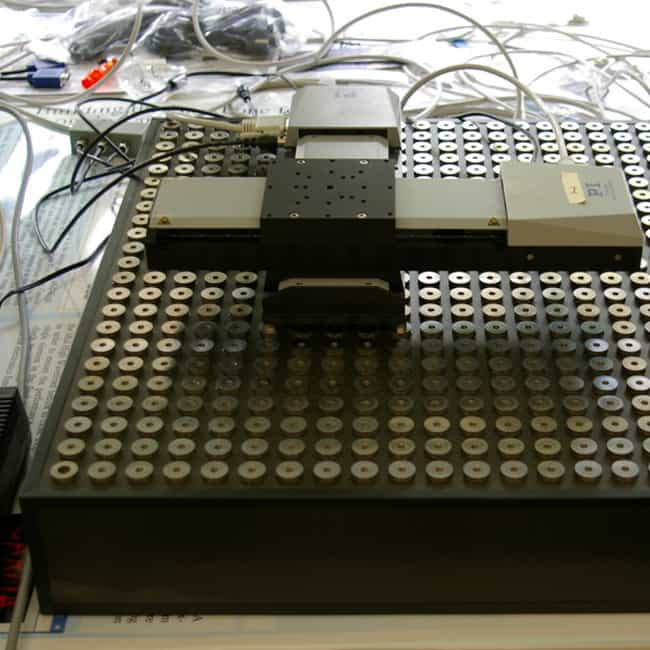
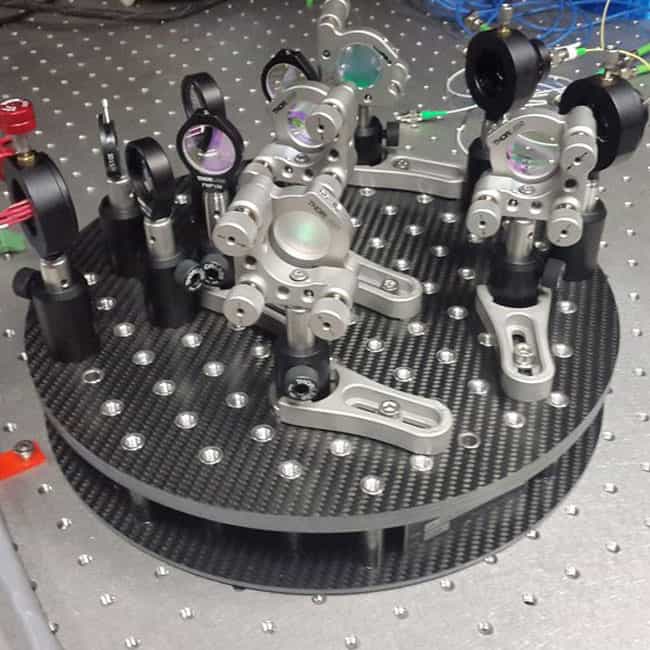
Compared with regular steel breadboards, carbon fibre breadboards typically weigh 75% less (size for size), exhibit 10% of the thermal expansion, possess damping coefficients that are up to 60% higher and provide a superior weight-to-stiffness ratio.
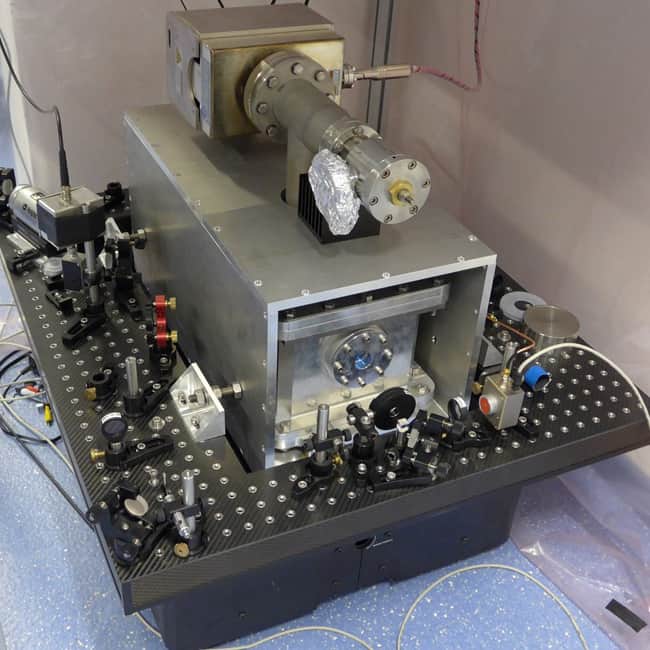
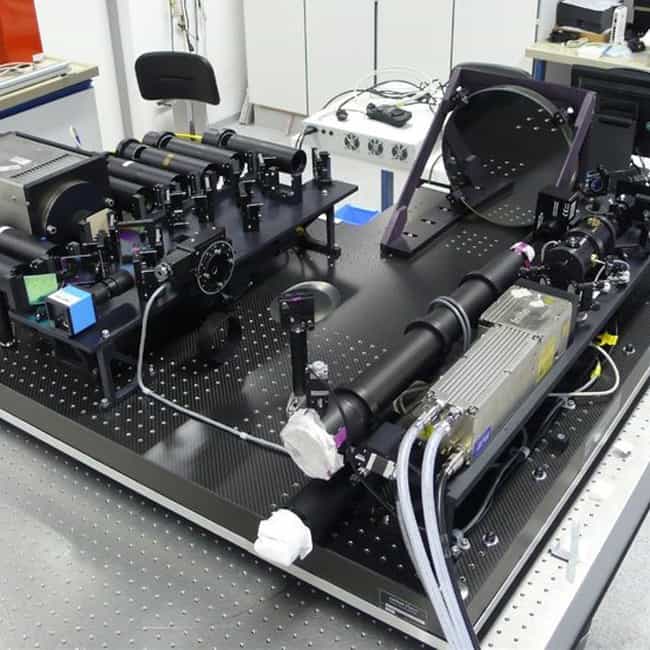
The low weight of carbon fibre boardboards will be of particular interest to those working with “mobile” systems, as will the fact that you can mount breadboards on top of breadboards in complex set ups. Precision is also important and the raised mounting surfaces of CarbonVision boards are ground to a flatness of ± 50 microns, with lateral position controlled to within ± 100 microns.
Vibrations are minimised due to the physical properties of carbon fibres embedded into a resin matrix, which is complemented by the behaviour of carbon fibre composites. Together, damping coefficients are up to 60% higher than regular steel boards. Supplementary elements placed inside the carbon fibre tubes which link the upper and lower faces of the boards allow the fine-tuning of resonant frequencies, which allows us to adapt the carbon boards to your specific requirements.
CarbonVision boards have an open design when configured for use in a clean room environment. The carbon fibre tube which is located below each mounting hole on the board allows easy cleaning by “pushing” contamination out. In the case of the CA-series, the side walls of the board can be completely removed, allowing thorough cleaning of the entire board.
The coefficient of thermal expansion for carbon fibre is typically 1/10th of that of steel. By selecting specific fibres or resins, and by optimising the orientation of the fibres, the coefficient can be further reduced. A lower coefficient of thermal expansion enhances the accuracy and precision of your experiments but also reduces the stabilisation time of the board, saving you time.
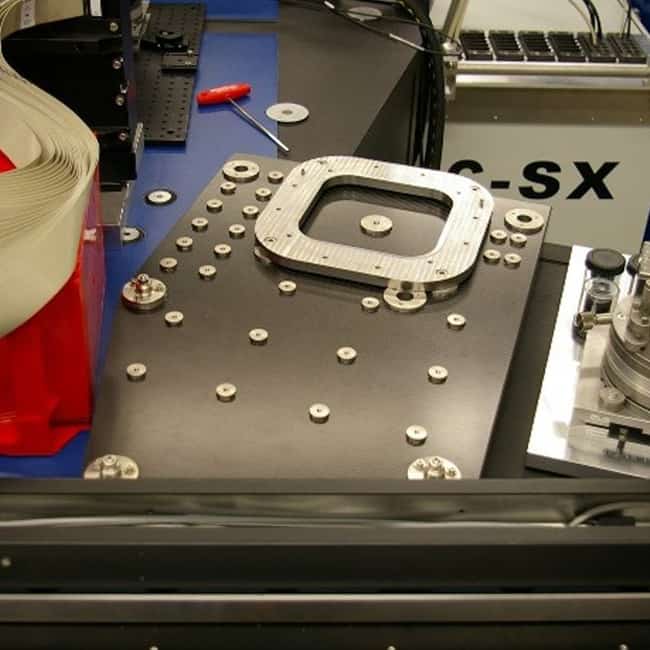
We offer carbon breadboards in standard and custom sizes from 300 x 300mm up to 1.2 x 2.5m and with thicknesses from 25 to 100mm. Non-standard sizes and shapes are available. The standard mounting system comprises stainless steel inserts with M6 holes on a 25 or 50mm grid.
x-Direction | y-Direction | z-Direction | |
Carbon EC-Series | 2.5 | 2.5 | 23.0 |
Carbon CA-Series | 2.5 | 2.5 | 0.1 |
Carbon SL-Series | 2.5 | 2.5 | 0.05 |
Steel | 10-12 | 10-12 | 10-12 |
Invar | 1.7-2.0 | 1.7-2.0 | 10-12 |
Aluminium | 23.0 | 23.0 | 12.0 |
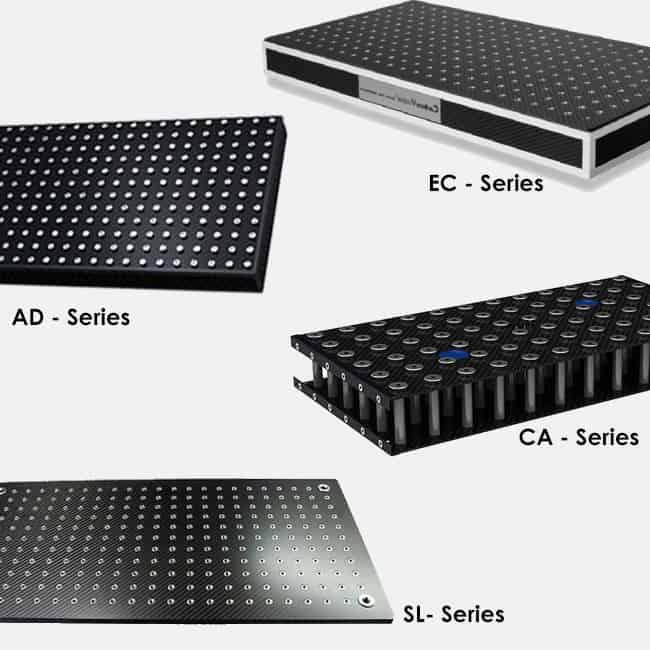
The EC-series breadboard is the cost-effective solution based upon honeycomb panels with various core materials. Stiffness and thermal stability can be adjusted by bonding additional plates made from carbon fibre reinforced plastic (CFRP) on the top or bottom face of the breadboard. Weight ~ 14kg/m2.

| Dimension | Typical breadboard sizes are available, maximum size 2000 x 2500 mm |
Thickness | Typical thickness ranges from 25, 50, 75 to 100 mm or according to structural requirements or customer needs |
Flatness | Flatness of entire mounting surface EC- Version ≤ 0.05 mm , ECI- Version ≤ 0.2 mm |
Mounting Grid | Typical mounting grid: 25×25 mm, 50×50 mm or customized |
Mounting Holes | Metric and imperial threads, inserts are made from stainless steel, Aluminium, Titanium or INVAR |
Damping | Nominal damping |
Thermal Expansion | Lateral directions CTEx,y = 2.5 · 10 E-6 [mm/mm·K] @ 273 K for plane plate |
Stiffness | Nominal stiffness |
Weight | Area weight approximately 14 kg/m² (50 mm grid) |
Design | – Honeycomb structure with skins made from multi-layered Carbon fiber fabrics cured with Epoxy Resin – Skins are designed typically to meet quasi-isotropic behaviour or according to structural/thermal requirements – High rigidity Aluminium or closed cell foam |
Top Side | Single inserts according to mounting grid, with first inserts 25 mm from edges or customized and sealed mounting holes |
Bottom Side | Single inserts with through holes at corners, 25 mm from edges or customized |
| Sidewalls | Carbon fiber plates with edge protection profiles |
| Ventilation | For vacuum applications core materials are ventilated |
Referenced breadboard is 600 x 900mm with 60mm thickness (steel) and 130mm (carbon). Stiffness is based upon a 22.7kg load placed in the centre of the board and a supported length of 0.56 x length.
Weight (kg) | Deflection (µm) | Thermal Expansion (mm/mm-K) | |
Carbon | 22.0 | 4 | 2.5 x 10⁻⁶ |
Steel | 54.0 | 2 | 10 … 12 x 10-6 |
The AD-series breadboard is an enhanced version of the entry-level EC-series. At each mount location, a CFRP tube links the top and bottom shell. The CFRP tubes (carbon fiber reinforced plastic) allow easy cleaning of the board, installation of additional, removeable mounts on the bottom face, tuning of the resonant frequency and vibrational damping by inserting adaptive elements. Weight ~ 15kg/m2.

| Dimension | Typical breadboard sizes are available, maximum size 2000 x 2500 mm |
| Thickness | Typical thickness ranges from 25, 50, 75 to 100 mm or according to structural requirements or customer needs |
| Flatness | Flatness of entire mounting surface AD- Version ≤ 0.05 mm , ADI- Version ≤ 0.2 mm |
| Mounting Grid | Typical mounting grid: 25×25 mm, 50×50 mm or customized |
| Mounting Holes | Metric and imperial threads, inserts are made from stainless steel, Aluminium, Titanium or INVAR |
| Damping | Nominal damping |
| Thermal Expansion | Lateral directions CTEx,y = 2.5 · 10 E-6 [mm/mm·K] @ 273 K for plane plate |
| Stiffness | Nominal stiffness |
| Weight | Area weight approximately 15 kg/m² (50 mm grid) |
| Design | – Honeycomb structure with skins made from multi-layered Carbon fiber fabrics cured with Epoxy Resin – Skins are designed typically to meet quasi-isotropic behaviour or according to structural/thermal requirements – High rigidity Aluminium or closed cell foam – CFRP tubes between upper and lower plate |
Referenced breadboard is 600 x 900mm with 60mm thickness (steel) and 130mm (carbon). Stiffness is based upon a 22.7kg load placed in the centre of the board and a supported length of 0.56 x length.
Weight (kg) | Deflection (µm) | Thermal Expansion (mm/mm-K) | |
Carbon | 22.0 | 4 | 2.5 x 10⁻⁶ |
Steel | 54.0 | 2 | 10 … 12 x 10-6 |
The CA-series breadboards are made entirely from carbon fiber resin plastic (CFRP). The top and bottom faces consist of CFRP shells, several mm thick and structurally joined by tubes made from CFRP. In addition to the advantages of the AD-series, CA-series breadboards allow integration of optical or electronic components and easy routing of wires and optical fibers within the stiff carbon shell. Weight ~ 19kg/m2.

| Dimension | Typical breadboard sizes, maximum size 2000 x 2500 mm |
| Thickness | Typical thickness ranges from 25, 50, 75 to 100 mm or according to structural requirements or customer needs |
| Flatness | Flatness of entire mounting surface CA- Version ≤ 0.05 mm , CAI- Version ≤ 0.2 mm |
| Mounting Grid | Typical mounting grid: 25×25, 50×50 mm or customized |
| Mounting Holes | Metric and imperial threads, inserts made from stainless steel, Aluminium, Titanium or INVAR |
| Damping | Nominal damping |
| Thermal Expansion | Lateral directions CTEx,y = 2.5 · 10 E-6 [mm/mm·K] @ 273 K for plane plate Vertical direction CTEz = -0.1 ÷ 0.5 E-6 [mm/mm·K] @ 273K for CFRP tube in axial direction |
| Stiffness | Nominal stiffness |
| Weight | Area weight approximately 19 kg/m² (50 mm grid) |
| Design | – Plate structure with spacer tubes and/or ribs. – Plates are designed typically to meet quasi-isotropic behaviour or according to structural/thermal requirements – Tubes are designed typically for high axial stiffness |
Referenced breadboard is 600 x 900mm with 60mm thickness (steel) and 130mm (carbon). Stiffness is based upon a 22.7kg load placed in the centre of the board and a supported length of 0.56 x length.
Weight (kg) | Deflection (µm) | Thermal Expansion (mm/mm-K) | |
Carbon | 22.0 | 38 | CTEx,y = 2.5 x 10⁻⁶ |
Steel | 54.0 | 2 | 10 … 12 x 10-6 |
SL-series breadboards are purpose designed for damping mechanical vibrations. The breadboards are made entirely from carbon, consisting of a top and bottom plate. The plates are structurally decoupled by a damping foil which is laminated in between the plates. SL-series breadboards are typically used as additional boards mounted on top of a larger breadboard.

| Dimension | Typical breadboard sizes, maximum size 2000 x 2500 mm |
| Thickness | Typical thickness ranges from 5 to 25 mm |
| Flatness | Flatness of entire mounting surface SL- Version ≤ 0.05 mm , SLI- Version ≤ 0.2 mm |
| Mounting Grid | Typical mounting grid: 25×25, 50×50 mm or customized |
| Mounting Holes | Metric or imperial threads, inserts made from stainless steel, Aluminium, Titanium or INVAR |
| Damping | Optimized damping |
| Thermal Expansion | Lateral directions CTEx,y = 2.5 · 10 E-6 [mm/mm·K] @ 273 K for plane plate |
| Stiffness | Nominal stiffness |
| Weight | Area weight approximately 22 kg/m² (25mm grid) |
| Design | – Plates are designed typically to meet quasi-isotropic behaviour or according to structural/thermal requirements – Plate structure with optional damping foil in-between |
| Top Side | Single inserts according mounting grid, with first inserts 25 mm from edges |
| Bottom Side | Single inserts with through hole at corners, 25 mm from edges or customized |
| Sidewalls | None |
| Vacuum | Suitable |
| Cleanroom | Suitable |
Damping | Mode | 1 | 2 | 3 |
Carbon | [%] | 5.7 | 4.8 | 5.6 |
Steel | [%] | 2.6 | 1.9 | 1.7 |
VERSION | CONCEPTION | OPTIONS | ADVANTAGES |
EC / ECI – Series | Based on CFRP Honeycomb or Sandwich panels | – EC = Protruding head inserts • Stiffness increase by CFRP plates | – Low costs |
AD / ADI – Series | Based on CFRP Honeycomb or Sandwich panels | – AD = Protruding head inserts • Stiffness increase by CFRP plates | – Easy cleaning |
CA / CAI – Series | Based on CFRP plates and Tubes | – CA = Protruding head inserts • Stiffness increase by tuning of internal geometry | – Easy cleaning |
SL/ SLI – Series | Based on CFRP plates | – Sl = Protruding head inserts • Damping Foil | – Flat and stiff |
Aerospace & Defence – Platforms for Simulations, Platforms for Laser Communication
Astronomy – Platforms for Optical Systems in Satellites, Platforms for Simulations, Platforms for Test Setup, Platforms for Astronomical systems
Environmental Sciences – Mobile Pollution Detectors, Leakage Detectors, Platforms for Airborne Systems, Nano Particle Analyzer
Medical Research – IR Microscopy, Flow Cytometers, Optical Biopsy
Physics – Platforms for Metrology Purposes, Non-Magnetic Boards in High Magnetic Fields, Platforms for Quantum Optics
Space & Space Research – Platforms for Optical Systems in Satellites, Platforms for Simulations, Platforms for Test Setup, Platforms for Astronomical systems