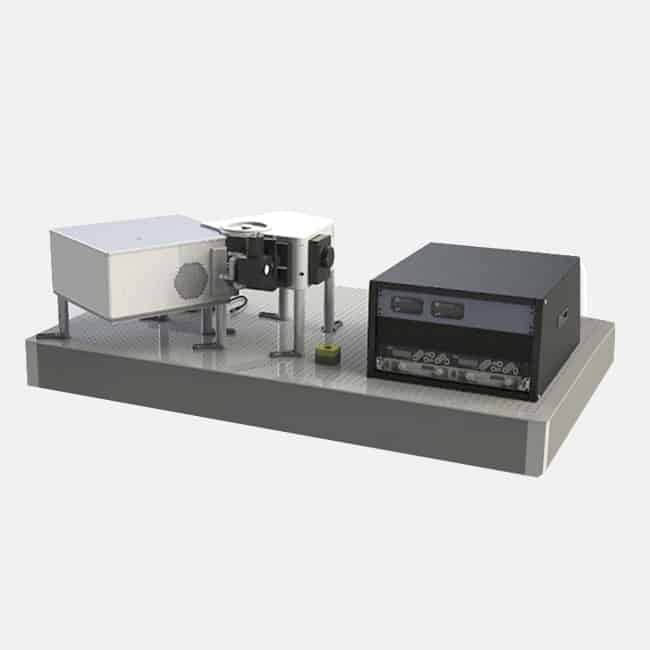
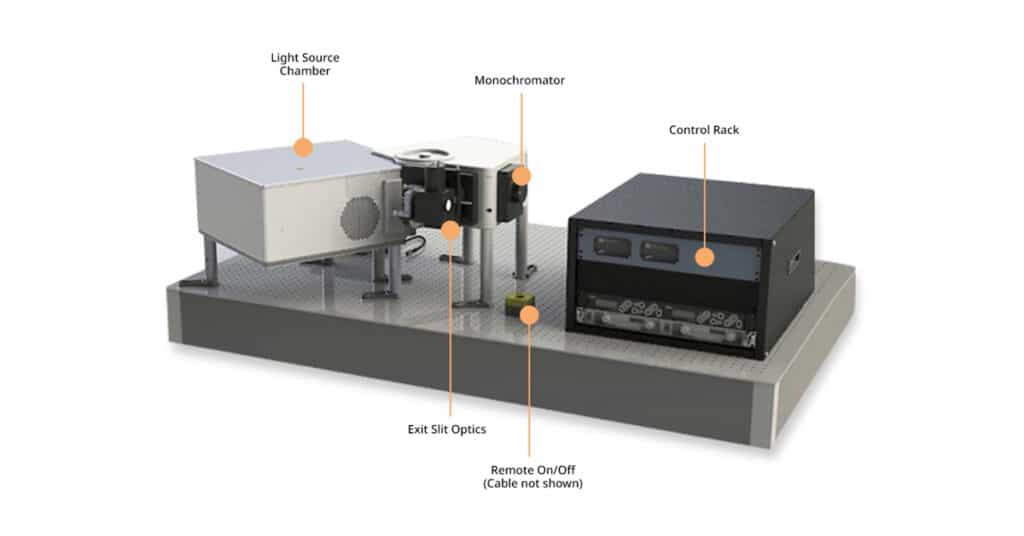
The Labsphere Spectra QT radiance standard is a spectrally tuneable uniform light source that provides uniform radiance or irradiance for testing the spectral responsivity, linearity and quantum efficiency of silicon-based image sensors. Using a monochromator engine coupled to an integrating sphere, the Spectra QT radiance standard outputs a spatially uniform, monochromatic radiance or irradiance from its 2.9cm exit port that is tuneable between 375-1100nm.
Measure Optical Sensor Quantum Efficiency & Spectral Responsivity
The Spectra QT-1000 radiance standard provides spectrally tuneable, uniform irradiance or radiance that is ideal for testing the spectral response of silicon based optical sensors. In the image sensor industry, accurate knowledge of a sensor’s electro-optical quantum efficiency is essential for optimising product performance. A well characterised sensor allows device integrators to specify and tailor the input optics and spectral filtering and apply performance enhancing corrections through the end product. The Spectra QT radiance standard is used for measuring the quantum efficiency, spectral irradiance responsivity, spectral radiance responsivity and linearity of silicon-based image sensors.
Tuneable, Uniform Irradiance & Radiance
The Spectra QT provides control of known levels of uniform monochromatic light over the spectral sensitivity range of silicon-based optical sensors between 375 and 1100nm. Uniform spectral irradiance across the entire sensor ensures consistent comparative results and correction. A detector attached to the QT-1000 integrating sphere is calibrated to monitor irradiance or radiance at the constituent wavelengths. With selectable apertures for defined F/#s ensure that you’ll always know the light levels delivered onto your sensor for a given field of view.
The QT-1000 seamlessly utilises two lamps for the highest sensitivity across the full UV-VIS and NIR spectral bands. A six-position neutral density filter wheel allows precise control of the light level delivered to the sensor under test.
Turnkey System Control
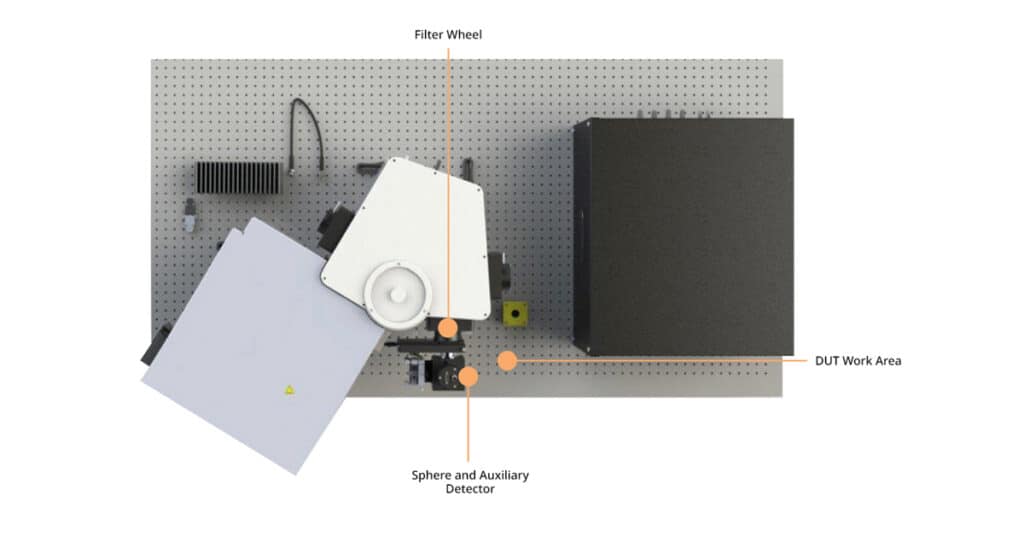
Compared with a “do it yourself” system approach based upon disparate components, the QT-1000 provides a turnkey solution with a user-friendly software interface. The QT-1000 GUI interface allows for complete control of light sources, spectral bandwidth, diffraction gratings, ND filter wheel, test wavelengths, and the irradiance and radiance sphere ports. In addition, the LS-QUEST LabVIEW API gives you complete control for synchronising testing with your sensor response.
Uniform Light Source Theory
An internally illuminated integrating sphere simplifies what would otherwise be complex procedures in the calibration and distortion correction of cameras and image sensors. Generating a field of uniform irradiance or radiance is not easy – unless you use an internally illuminated integrating sphere. Any light entering a sphere reflects with equal radiance in all directions from the diffusely reflecting (Lambertian) sphere wall coating. The high reflectance coating (typically 96-99%) ensures a high number of reflections, resulting in a near-perfectly uniform radiance at all points on the sphere wall. The open exit port on an internally illuminated integrating sphere is the “uniform source”. The sphere can be illuminated by lamps or LEDs placed inside the sphere or held outside at a sphere port.
A uniform light source integrating sphere functions both as a source of uniform radiance and irradiance. A camera whose lens is focussed onto the plane of the exit port of the sphere collects defocussed light from the sphere wall opposite. The irradiance is uniform at all points on the sphere wall, and the wall reflects light with constant radiance at all angles. Therefore, the camera sees a field of uniform radiance or luminance.
Without imaging optics, the integrating sphere would deliver a field of uniform irradiance directly onto an image sensor. An image sensor placed directly in the plane of the exit port of the sphere receives uniform (but diffuse) irradiance. Note that the irradiance uniformity decreases in the near-field, but recovers in the far-field.
The Need for Uniform Radiance/Irradiance with Image Sensors & Cameras
Focal plane array (FPA) image sensors (PDA, CMOS, CCD etc) suffer from pixel-to-pixel differences in responsivity (photo response non-uniformity, PRNU) as well as photon (shot) noise, dark (thermal) noise, read noise and non-linearity. By placing the sensor at the exit port of a uniform light source, we uniformly illuminate each pixel on the array and can perform pixel gain and offset normalisation.
An imaging system (reflective or refractive) introduces additional distortions with angle: vignetting and cos4 intensity drop-off. An integrating sphere uniform light source provides spatially and angularly uniform radiance and allows the camera (sensor with lens) to be flat field corrected.
| Spectra QT-1000 |
Light Source | Scanning monochromator with separate UV & VIS-NIR lamps |
Spectral Range | 375-1100nm |
Radiometric Performance | Irradiance: 21µW/cm2 @ 600nm Radiance: 54µW/sr.cm2 @ 600nm |
Illumination Geometry | Integrating sphere |
Exit Port Diameter | 29mm |
Radiance Uniformity | ±1% at f/2 at 64mm2 |
Irradiance Uniformity | ±1% |
Interface | USB & RS232 |
Software | Included, Windows 10 compatible, LS-QUEST with LabVIEW API |
Calibrations | TBA |
Power | 110-240V AC, 50/60Hz |
Dimensions & Weight (Table) | 183 x 122 x 68cm, 285kg |
Dimensions & Weight (Rack) | 53 x 62 x 32cm, 18kg |
Focal plane array (FPA) image sensors (PDA, CMOS, CCD etc) suffer from pixel-to-pixel differences in responsivity (photo response non-uniformity, PRNU) as well as photon (shot) noise, dark (thermal) noise, read noise and non-linearity. By placing the sensor at the exit port of a uniform light source, we uniformly illuminate each pixel on the array and can perform pixel gain and offset normalisation.
An imaging system (reflective or refractive) introduces additional distortions with angle: vignetting and cos4 intensity drop-off. An integrating sphere uniform light source provides spatially and angularly uniform radiance and allows the camera (sensor with lens) to be flat field corrected.
The Labsphere Spectra QT spectrally tuneable radiance and irradiance standard is ideal for measuring the quantum efficiency, spectral irradiance responsivity, spectral radiance responsivity and linearity of silicon-based image sensors.