
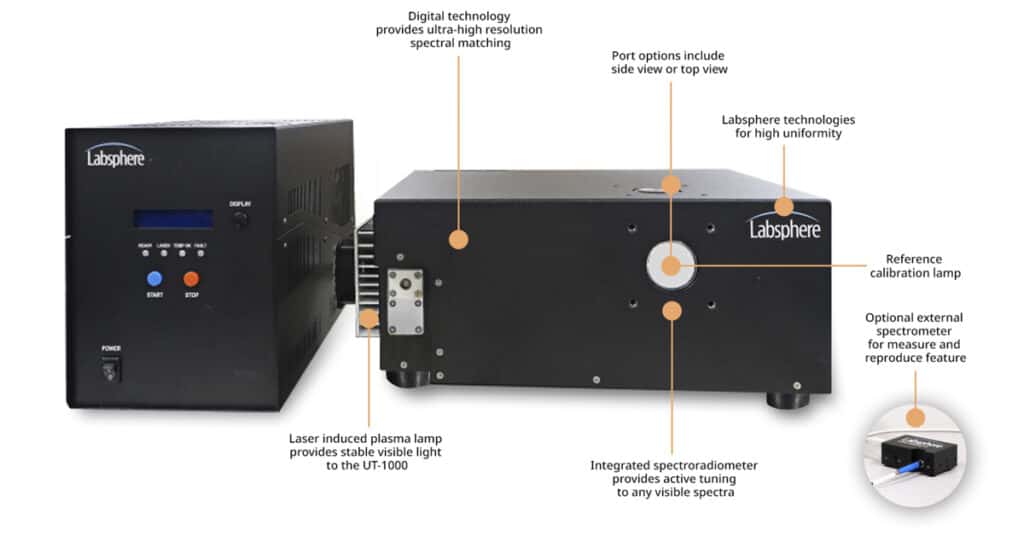
The Labsphere Spectra UT luminance standard is a uniform light source that incorporates a digital polychromator light engine that allows you to precisely tune the output spectra to match that of your target reference illuminant with a very high fidelity. The Spectra UT provides for a continuously adjustable spectrum and colour in the visible light range from 390-780nm. The Spectra UT is ideal for calibrating colorimeters and spectroradiometers, for correcting tristimulus colour mismatch errors and to optimise display colour reproduction.
Create Your Own Spectrum with High Fidelity
With the Spectra UT you can create your own, almost infinitely variable spectral power distribution, or select from predefined standard CIE illuminants or black body spectra. Of note is that the Spectra UT can be set accurately simulate OLED, Micro LED and LED displays spectral power distributions. By exploiting a digital polychromator light engine, almost any target spectrum can be recreated with unprecedented fidelity. Luminance is adjustable from 25 to 1,000 cd/m2, whilst the luminance uniformity across the 36mm exit port is specified at 99%.

Real-Time Spectral Monitoring
An integrating internal spectroradiometer with QTH calibration lamp offers real-time spectral performance tracking over the dynamic range of the Spectra UT. Recalibration and recharacterisation features ensure long life performance and minimal downtime making Spectra UT sources ideal for production applications.
The Spectra UT Family
The Labsphere Spectra UT spectrally tuneable luminance standards is available in two versions. The UT-1000-S is equipped with a side facing 36mm diameter exit port. The UT-1000-D comes an exit port located at the sphere’s north pole position.
Uniform Light Source Theory
An internally illuminated integrating sphere simplifies what would otherwise be complex procedures in the calibration and distortion correction of cameras and image sensors. Generating a field of uniform irradiance or radiance is not easy – unless you use an internally illuminated integrating sphere. Any light entering a sphere reflects with equal radiance in all directions from the diffusely reflecting (Lambertian) sphere wall coating. The high reflectance coating (typically 96-99%) ensures a high number of reflections, resulting in a near-perfectly uniform radiance at all points on the sphere wall. The open exit port on an internally illuminated integrating sphere is the “uniform source”. The sphere can be illuminated by lamps or LEDs placed inside the sphere or held outside at a sphere port.
A uniform light source integrating sphere functions both as a source of uniform radiance and irradiance. A camera whose lens is focussed onto the plane of the exit port of the sphere collects defocussed light from the sphere wall opposite. The irradiance is uniform at all points on the sphere wall, and the wall reflects light with constant radiance at all angles. Therefore, the camera sees a field of uniform radiance or luminance.
Without imaging optics, the integrating sphere would deliver a field of uniform irradiance directly onto an image sensor. An image sensor placed directly in the plane of the exit port of the sphere receives uniform (but diffuse) irradiance. Note that the irradiance uniformity decreases in the near-field, but recovers in the far-field.
The Need for Uniform Radiance/Irradiance with Image Sensors & Cameras
Focal plane array (FPA) image sensors (PDA, CMOS, CCD etc) suffer from pixel-to-pixel differences in responsivity (photo response non-uniformity, PRNU) as well as photon (shot) noise, dark (thermal) noise, read noise and non-linearity. By placing the sensor at the exit port of a uniform light source, we uniformly illuminate each pixel on the array and can perform pixel gain and offset normalisation.
An imaging system (reflective or refractive) introduces additional distortions with angle: vignetting and cos4 intensity drop-off. An integrating sphere uniform light source provides spatially and angularly uniform radiance and allows the camera (sensor with lens) to be flat field corrected.
| Spectra UT Series |
Light Source | Spectrally tuneable digital polychromator light engine |
Spectral Range | 390-780nm |
Photometric Range | 25-1,000 cd/m2 |
Illumination Geometry | Integrating sphere |
Exit Port Diameter | UT-1000-S: 36mm exit port, side facing UT-1000-D: 36mm exit port, upwards facing |
Luminance Adjustment |
|
Luminance Spatial Uniformity | 99% (COV) |
Monitor Detector | Integrated spectroradiometer with programmable feedback control |
Interface | USB 3.0 or TCP |
Software | Included, Windows 10 compatible, LabVIEW runtime |
Calibrations | TBA |
Power | 110-240V AC, 50/60Hz |
Dimensions/Weight | 15 x 36 x 24cm, 7kg (plus separate power supply) |
Focal plane array (FPA) image sensors (PDA, CMOS, CCD etc) suffer from pixel-to-pixel differences in responsivity (photo response non-uniformity, PRNU) as well as photon (shot) noise, dark (thermal) noise, read noise and non-linearity. By placing the sensor at the exit port of a uniform light source, we uniformly illuminate each pixel on the array and can perform pixel gain and offset normalisation.
An imaging system (reflective or refractive) introduces additional distortions with angle: vignetting and cos4 intensity drop-off. An integrating sphere uniform light source provides spatially and angularly uniform radiance and allows the camera (sensor with lens) to be flat field corrected.
The Labsphere Spectra UT luminance standard serves as a high fidelity spectrally tuneable source of unform luminance or illuminance for calibrating imaging systems and optical sensors with your chosen reference illuminant or spectral power. With the Spectra UT, you can correct the colour mismatch errors of your light meters to the spectrums you’re going to test, making it ideal for the test and correction of spectrometers and colorimeters used for testing displays and sensor response to multiple illuminants and RGB sources.
The Labsphere Spectra UT luminance standard is well suited for the following applications:
Imager and image sensor performance parameters that can be tested and optimised with a Spectra UT luminance standard include:

