
The SSL Flicker Meter is a portable, battery operated irradiance spectroradiometer with auxiliary flicker capability that can be used either as a versatile handheld light meter, or as part of an SSL goniophotometer system for testing the output of lamps, LEDs and luminaires, vehicle lighting or transportation signage.
Part of the SSL Spektri 80 spectroradiometer family, the SSL Flicker Meter – also known as the Spektri 80 ColorLux model – provides for measurements of flicker in addition to spectral irradiance in the 380-780nm range, illuminance, CIE chromaticity, correlated colour temperature, colour rendering and PAR metrics for horticultural lighting products.
The Spektri 80 communicates via Bluetooth and an Android app for your smart phone is supplied as standard, while Windows software for your PC can be ordered as an option.
Goniophotometric Measurements
When deployed as part of an SSL goniophotometer system, the Spektri 80 ColorLux provides access to a comprehensive dataset for the light source under test. Apart from measuring flicker, the SSL system will report the angular luminous intensity variation, spatial illuminance distribution, the total luminous flux, the colour of the light source (correlated colour temperature and CIE chromaticity), and the colour rendering. It can also be programmed to measure the variation in CCT as a function of angle, capturing the undesirable blue-to-yellow annular colour shift that can sometimes be seen with phosphor-converted blue LED lamps.
SSL Flicker Meter Flicker Measurement Parameters
Comparison of SSL Spectroradiometers SPECTRI 80 Models
Product Family | SPEKTRI 80 (SSL S-80) | |||||
Product Code | S-80.PAR | S-80.Ee | S-80.Color | S-80.ColorLux | S-80.Lv | S-80.Lab |
Product Name | SPEKTRI 80, Horti | SPEKTRI 80, Irradiance | SPEKTRI 80, Color | SPEKTRI 80, Colorlux | SPEKTRI 80, Luminance | SPEKTRI 80, Laboratory |
Application Areas | Horticulture, Agriculture | Medical, Dental | General lighting | General lighting | Display, Automotive | General spectroscopy |
Measuring Parameters | ||||||
Illuminance Ev | ✔ | ✔ | ✔ | ✔ | ✔ | |
Irradiance Ee | ✔ | ✔ | ✔ | ✔ | ✔ | ✔ |
Radiance Le | ✔ | ✔ | ||||
Luminance Lv | ✔ | ✔ | ||||
Flicker (MI, FI, f) | ✔ | |||||
CCT, ccxy, ccu’v’ | ✔ | ✔ | ✔ | ✔ | ✔ | |
SDCM | ✔ | ✔ | ✔ | ✔ | ||
CRI / TM30 | ✔ | ✔ | ✔ | ✔ | ||
Spectrum | ✔ | ✔ | ✔ | ✔ | ✔ | ✔ |
PAR | ✔ | ✔ | ✔ | ✔ | ||
Battery Operated | ✔ | ✔ | ✔ | ✔ | ✔ | |
BT Connection | ✔ | ✔ | ✔ | ✔ | ✔ | |
USB Data Readout | ✔ | |||||
Android App | ✔ | ✔ | ✔ | ✔ | ✔ | |
PC software (SSL SRM sw) | Optional | Optional | Optional | Optional | Optional | ✔ |
Export to Excel | ✔ | ✔ | ✔ | ✔ | ✔ | ✔ |
What is Flicker?
Flicker is defined as a temporal variation in light intensity and is a characteristic of every light source or display, to a varying degree. A lamp that is driven directly from a mains electricity supply will suffer from an AC perturbation. Examples include incandescent lamps and fluorescent lamps, more so if the latter is equipped with old fashioned magnetic ballasts. Displays will also flicker at a frequency that depends on their design refresh rate.
Even LEDs can suffer from a surprisingly high level of flicker despite being nominally driven with a DC current. Modern semiconductor light sources have a lot shorter response time than traditional filament lamps. This makes LED-based lighting products more vulnerable to power-line flicker. In addition, fast temporal modulation of LED sources via pulse width modulation (PWM) is frequently used, for example when dimming.
Temporal light modulation becomes visible if the modulation frequency is below a certain frequency. Above this threshold, an intermittent light stimulus appears to be steady state. This visible light modulation is called light flicker or just flicker. The frequency below which light flicker appears is different in different conditions but is usually between 60 and 400 Hz.
Flicker can be both invisible and innocuous but depending on the flicker frequency and the depth of modulation, flicker can sometimes present a serious hazard in workplaces and elsewhere. A piece of rotating machinery can appear to be static if illuminated by a lamp that suffers from flicker at the wrong frequency and depth of modulation. In addition, flicker is associated with several health concerns, particularly to those who suffer from photosensitive epilepsy. Flicker can also lead to eye strain, headaches and can trigger migraines.
How is Flicker Measured?
Flicker is measured using a fast photodiode or photometer. A spectrometer is not normally suitable for flicker measurements due to a more limited bandwidth. There are several metrics used to quantify the degree of flicker present in a display or light source.
As of 1st September 2021, the European Union requires that the flicker level be measured and reported for luminaires. Commission Regulation (EU) 2019/2020 of 1st October 2019 refers. The flicker metrics mandated by the EU regulation are the SVM and PstLM, details of which follow.
What are the Flicker Metrics for Lighting Products?
Flicker Frequency (Hz)
Describes the repetition speed of the light intensity variation. The frequency does not depend on the waveform shape. Flicker frequency is expressed in Hertz (Hz), the inverse of the time period of one cycle.
Percent Flicker
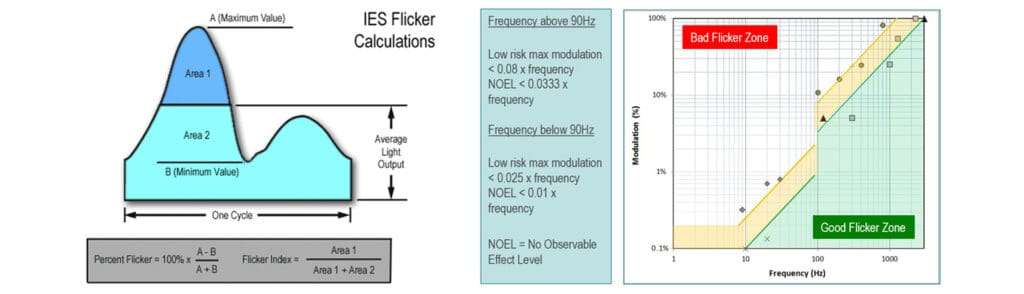
Percent flicker, also known as the modulation index, also does not depend on the waveform shape and is computed based upon the intensity maxima (A) and minima (B) in the waveform according to the formula below:
Percent Flicker = (A-B)/(A+B)*100%
This is shown in the diagram below. Percent flicker varies from 0% (no flicker) to 100%.
Flicker Index
The flicker index metric considers the shape of the waveform, as shown below. It compares the area in one cycle above the average light output to that below it, according to the following formula:
Flicker Index = Area 1/ (Area 1 + Area 2)
The IEEE publication 1789-2015 classifies flicker by percent flicker and flicker frequency in three categories: no observable effect level (NOEL, shaded green in the diagram below); low-risk (shaded yellow); and risk (shaded red).
Stroboscopic Effect Visibility Measure (SVM)
The SVM measures the visibility of flicker.
The Stroboscopic Visibility Measure (SVM) takes into account the effect on appearance of moving objects when illuminated with flickering light at up to 2kHz. It applies for illuminance levels greater than 100 lux and for motion speeds equivalent to those of a typical hand movement. A detailed description of SVM is presented in CIE technical note TN006 and IEC TR 63158. If SVM<1, flicker is not visible, if SVM=1 flicker is just visible and if SVM>1 flicker is visible.
Short Term Perceptibility of Light Modulation (PstLM)
PstLM also measures the visibility of light flicker. Higher PstLM values mean more visible flicker.
Commission Regulation (EU) 2019/2020 of 1st October 2019 and IEC TR 63158 have set the pass criteria for SVM and PstLM. The maximum allowed value is 0.4 for SVM and 1 for PstLM measured at full load (except for HID sources when the luminous flux used is more than 4,000 lumens and for light sources intended for use in outdoor applications, industrial applications or other applications where lighting standards allow a CRI< 80).
What are the Flicker Metrics for Display Products?
The two most common metrics applied to the flicker produced by a display monitor are the contrast flicker and the flicker measured according to the JEITA method.
Contrast Flicker
In general, flicker for any source – display or lamp – is determined as the ratio of the magnitude of an AC perturbation compared to the DC or mean signal in the measured temporal luminance waveform. The contrast flicker for a display is calculated per:
Contrast Flicker = (max-min)/average*100% (%)
Contrast Flicker = 10 log10 (max-min)/average (dB)
JEITA Method
The Japan Electronics and Information Technology Industries Association (JEITA) publishes a flicker metric for LCD displays. The JEITA calculation is based upon a frequency domain calculation and uses an fast Fourier Transform (FFT) to determine both AC and DC levels of the measured luminance waveform and translates the signal into an FFT. In effect, you analyse the frequency component of the fluctuation and determine the flicker from the ratio of the DC and maximum AC components at up to 60Hz. A weighting factor is applied to allow for the human vision system’s sensitivity to frequency.
We define P0 as the DC level and P1 as the smallest detectable AC signal in frequency space. Pr0 and Pr1 are the aforementioned values scaled to the human eye sensitivity to frequency.
JEITA flicker is thus calculated according to:
FlickerJEITA = 20 log10 (Pr1/Pr0) (dB)
VESA Method
VESA (formerly the Video Electronics Standards Association) flicker metric involves essentially the same calculation as for the JEITA flicker metric, but with a small difference in the resultant flicker value arising due to the squaring of amplitudes in the FFT.
FlickerVESA = FlickerJEITA + 20 log10 (2-½) (dB)

