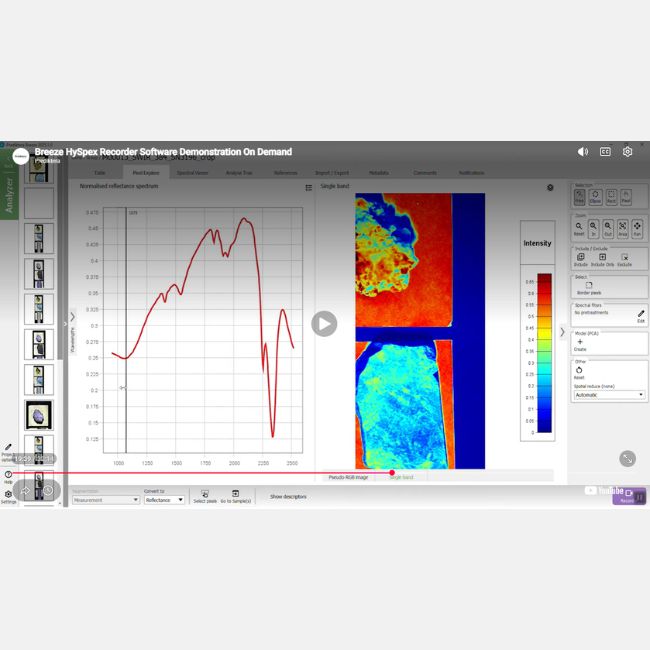
Selecting a hyperspectral camera is only the first step in getting started with spectral imaging. To fully realise the potential of hyperspectral data, it’s equally important to use powerful yet user-friendly software solutions such as Breeze.
Prediktera’s Breeze software simplifies both the acquisition and processing of hyperspectral data. Its intuitive interface makes it accessible even to users without specialised expertise, while still offering advanced functionality. Breeze includes a range of visualisation tools—such as spectral plots and scatter plots—that help users explore and interpret their data more effectively. In addition, it features machine learning and chemometric capabilities for real-time classification, quantification, and identification of materials or objects. Users can streamline workflows by automating repetitive tasks, building data-processing pipelines, and developing custom scripts tailored to their needs.
The Breeze HySpex Recorder software is provided free of charge with HySpex cameras, giving users immediate access to essential data acquisition tools. It also comes with a 30-day free trial of the full Breeze software, enabling customers to explore the extended analysis features available within the complete package.
Prediktera software comes fully featured for advanced data analysis and powerful data visualisation. It’s easy to get started and easy to extend with custom algorithms when needed.
Modelling and data analysis
| Object identification and image segmentation
|
Classification
Classification is a powerful technique in spectral imaging that can provide valuable insights into the materials and objects present in a scene and can help users to make informed decisions for a variety of applications.
Classification algorithms use statistical techniques to group pixels in the hyperspectral data cube into distinct classes based on their spectral properties. These classes represent different materials or objects within the scene, such as vegetation, water, soil, or buildings. The goal of classification is to identify and distinguish between these different materials or objects in the scene, which can provide valuable information for various applications, such as land use mapping, environmental monitoring, and mineral exploration.
There are different classification methods available for spectral imaging, including supervised and unsupervised methods. Supervised classification involves training the algorithm using a subset of the data that has already been labelled or identified, and then applying the algorithm to the remaining data to classify it into the same classes. Unsupervised classification, on the other hand, does not require prior knowledge of the classes and automatically groups the pixels in the data into distinct classes based on their spectral properties.
Quantification
Quantification in spectral imaging refers to the process of estimating the amount or concentration of a particular material or substance present in a scene based on its spectral properties.
Quantification algorithms use statistical techniques to estimate the concentration or amount of a particular material or substance in the scene based on its spectral signature. These algorithms typically require calibration data to establish a relationship between the spectral signature and the concentration of the material or substance of interest. Once this relationship is established, the algorithm can be used to estimate the concentration of the material or substance in the scene based on its spectral signature.
Identification
Classification and identification are two distinct but related techniques in spectral imaging. Identification refers to the process of recognizing and classifying individual objects or features within an image based on their spectral properties. It involves identifying specific objects or features within the image and assigning them to pre-defined classes based on their spectral characteristics. Identification can be performed using object-based or pixel-based methods and is typically used for applications such as object detection, target recognition, and geological mapping.
Machine Learning and Chemometrics
Breeze hyperspectral software incorporates machine learning and chemometric features in several ways:
The complete tool for hyperspectral imaging
Breeze is Prediktera’s premiere software solution enabling a wide range of hyperspectral imaging applications.
It is used in research, application development, routine analysis and easily extends into real-time industrial analysis solutions using the Breeze Runtime software.
• Speed up research and development of applications
• User friendly interface for experts and beginners
• For research and for industry
Use areas
• Data acquisition
• Data analysis
• Develop and run applications
• Real time analysis
Main features
• User-friendly interface for expert and non-expert
• Control compatible cameras, sample movers and scanner tables
• Record image data directly from the camera
• Import image files from hard drive (compatible with most standard image data file formats)
• Exploratory analysis of images and spectrum
• Build data processing workflows for automated analysis
• Image segmentation and object recognition
• Classification and quantification analysis
• Real-time analysis and visualisation
• Extensive list of analysis techniques: Machine learning, chemometrics, spectral library, band math, neural networks and other algorithms
• Python interface and external neural nets (.onnx)
Software for geological hyperspectral imaging applications
Prediktera’s software for mineral analysis using hyperspectral imaging offers a fast and easy solution that empowers you to take full control of your mineral analysis and data. Streamline your workflow with automated analysis that can be run by non-experts. Breeze Geo provides an all-in-one solution that covers every step from data acquisition and analysis to logging and exporting of mineralogic interpretations.
Use Areas
• Data acquisition
• Data analysis
• Mineral mapping
• Logging and exporting of mineralogic interpretations
Main Features
• Core logging and depth registration
• USGS PRISM MICA mineral mapping using built in spectral library
• Spectral feature modelling (MWL)
• User created libraries and models
• User-friendly interface for expert and non-expert
• Control cameras, sample movers and scanner tables
• Record image data directly from the camera
• Import image files from hard drive (compatible with most standard image data file formats)
• Exploratory analysis of images and spectrum
• Build data processing workflows for automated analysis
• Image segmentation and object recognition
• Classification and quantification analysis
• Real-time analysis and visualisation
• Extensive list of analysis techniques: Machine learning, chemometrics, spectral library, band math, neural
networks and other algorithms
• Python interface and external neural nets (.onnx)
Integrated real-time analysis
Hyperspectral imaging for machine builders, integrators, and industrial applications. Breeze Runtime is here to make it easy for you to implement hyperspectral image analysis into your systems and processes. Breeze
Runtime enables real-time quantification, classification and object identification of materials being scanned online in processes.
Use Areas
• Run applications developed in Breeze
• Integrate with external process systems
• Sorting, monitoring and quality control
Main Features
• Easy deployment of your hyperspectral imaging analysis workflow
• Fast and stable real time data processing for demanding applications running at high speed
• Flexible programmable interface (API) and web client for sending and receiving data
• Light client for visualisation, testing and diagnostic
Integrated real-time analysis
Hyperspectral imaging for machine builders, integrators, and industrial applications. Breeze Runtime is here to make it easy for you to implement hyperspectral image analysis into your systems and processes. Breeze Runtime enables real-time quantification, classification and object identification of materials being scanned online in processes.
Use areas
• Run applications developed in Breeze
• Integrate with external process systems
• Sorting, monitoring and quality control
Main features
• Easy deployment of your hyperspectral imaging analysis workflow
• Fast and stable real time data processing for demanding applications running at high speed
• Flexible programmable interface (API) and web client for sending and receiving data
• Light client for visualisation, testing and diagnostic
Explorative analysis of hyperspectral images
Evince is the ultimate software for analysing hyper- and multi-spectral images. This powerful research toolbox enables you to use multivariate modelling techniques to explore, analyse and understand the chemical information hidden in your images and data. Its flexible graphical user interface provides a wide range of visualisations and a clear interaction between data and graphics makes the exploration fast and effective.
Main Functionalities:
• Powerful interactive graphics for exploration of spectral data, images and models.
• Flexible visualisation of your images and data, e.g. plots, graphs, and tables etc.
• Classification and quantification of image data using chemometric techniques:
o PCA
o PLS
o PLS-DA
o SIMCA
• Flexible import and export of a large variety of image and data formats including:
o RAW, MAT, PNG, JPEG, TIFF, XLS, CSV etc.
Product Info
Application Notes
Videos
Thanks for getting in touch!
Our team will respond as soon as possible.
Product Enquiry
Please complete all fields