By Dr Nick Barnett, April 2023
Introduction
Spectral imaging is a powerful analytical tool that provides a wealth of information about the chemical and physical properties of a sample. By collecting and analysing light at different wavelengths, it is possible to identify and map the distribution of various chemical species in a sample with high sensitivity and specificity.
However, despite its potential benefits, spectral imaging is generally limited in uptake due to its high cost. The technology involved in hyperspectral imaging can be complex and require specialised equipment, expertise, and data analysis software, which can be expensive to acquire and maintain. This makes it challenging for researchers and organisations with limited budgets to adopt spectral imaging as a routine analytical tool.
Nonetheless, as the demand for more accurate and detailed information about the composition of materials continues to grow in fields such as materials science, pharmaceuticals, and environmental monitoring, the potential of spectral imaging is becoming increasingly apparent. Efforts are being made to make the technology more accessible, such as developing low-cost portable spectral cameras and open-source software for data analysis.
With continued advancements in technology and increased awareness of its potential benefits, it is hoped that spectral imaging will become more widely adopted in the future.
A New Approach to Affordable High Performance Spectral Imaging
Hinalea Imaging is a company that is dedicated to promoting the wider uptake of spectral imaging by promoting a new technology that is both highly flexible and much more affordable. By utilising cutting-edge technology and innovative approaches, Hinalea is driving down costs and expanding the accessibility of hyperspectral imaging to a wider range of users.
Hinalea is achieving these advances using spectral cameras based upon Fabry-Perot interferometer (FPI) technology. These tunable filters can be designed to be very compact and robust. They can also be used throughout a wide spectral range by combining them with sensors with sensitivity in the UV, VIS, NIR, or SWIR bands. Furthermore, FPIs are produced using a semiconductor-type process which can be scaled to higher volumes, so there is significant potential to realise economies of scale in volume production.
Fabry-Perot interferometers function by placing two semi-reflective/transmissive mirrors parallel to each other. The transmission of specific wavelengths is determined by constructive and destructive interference that occurs within the cavity, between the mirrors (Figure 1). In its simplest interpretation, certain mirror distances or gaps can be considered to allow transmission of a single waveband. However, many gap settings transmit multiple bands.
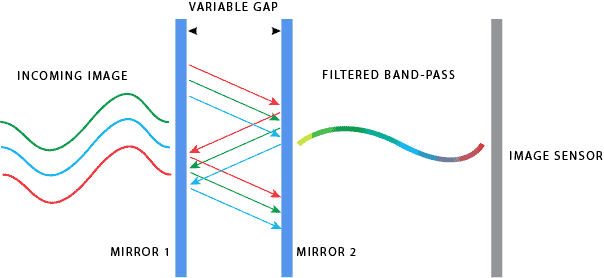
Figure 1: Principle of operation of a Fabry-Perot interferometer spectral imager
When the FPI is positioned in front of a 2D image sensor, transmission spectral bands are selected sequentially, producing an image hyper-cube. In this way, Fabry-Perot interferometer cameras provide great spectral flexibility as they can be used both in a hyperspectral capture mode, acquiring hundreds of wavebands, or in a multi-spectral capture mode where the data acquisition is limited to just a few wavebands. This inherent flexibility is a key attribute of this technology.
Hyperspectral cameras collect a large number (up to several hundred) of distinct, yet contiguous bands across a wide spectral range. This detail is required for some applications where the detection of subtle changes in spectral signatures is required. However, there are many applications where multispectral measurements based upon just a handful of wavebands will suffice.
FPI spectral cameras can be used in an application development mode to collect hyperspectral images and the data analysed to determine the critical wavebands for a specific measurement. The camera can potentially then be run in a multi-spectral mode, just selecting those key wavebands. This makes image acquisition faster and reduces the size of the spectral image files.
Interestingly, many FPI gap settings (positions) transmit multiple spectral bands. It’s thus possible to take advantage of these positions to speed up capture of the data-cube. For example, it is possible to switch between just a few gap settings to capture multiple spectral bands. The multi-band pass intensity images are converted into data-cubes using a reconstruction algorithm which also utilises proprietary machine learning and calibration techniques. This improves the signal-to-noise ratio (SNR), spectral range, and resolution, which are otherwise not possible with this method. By operating in multi-spectral mode, it is possible to operate these cameras with near real-time spectral image classification.



The Hinalea 4250 spectral camera is based on a Fabry-Perot interferometer placed in front of a 2.3-Megapixel silicon camera sensor. It covers the visible and near infrared wavelength range from 400 to 1000nm with 4nm spectral resolution. The tunable filter sequentially selects spectral bands to generate a hyper-cube.
Figure 2 shows the intensity and reflectance spectra obtained from different areas on a Macbeth Colour Chart using the 4250 camera together with incandescent white light illumination. The intensity spectra show the raw spectral data from the areas selected on the main image. Reflectance spectra can be generated once reference white and dark spectra have been saved as well.

Figure 2: Intensity and reflectance spectra obtained from different areas on a Macbeth colour chart using a Hinalea 4250 spectral camera.
Figure 3 shows spectral images captured from standard gel filters. As expected, the reflectance spectra show many of the spectral characteristics also observed in the manufacturer’s transmission spectral plots.

Figure 3: Spectral images obtained from gel filters using a Hinalea 4250 spectral camera.
The Hinalea 4400 spectral camera is a SWIR version of the FPI-based technology based upon an InGaAs sensor with 640 x 512 pixels. It covers the spectral range from 1,000 to 1,700nm producing 108 bands with a spectral resolution of 10-45 nm (FWHM).
Figure 4 shows a spectral image of a selection of white pills (Tylenol, Metformin and Amoxicillin) that all look white in the visible spectrum. The SWIR reflectance spectra of the pills are displayed to the right of the image and the image displays the pills classified according to their spectra using a spectral angle mapping feature within the Hinalea software.

Figure 4: SWIR spectral image of Tylenol, Metformin and Amoxicillin tablets recorded using the Hinalea 4400 spectral camera.
The Hinalea cameras can also be connected to microscope platforms using a microscope adapter without the need for any additional translation stages. Connection is simple via a c-mount connection.

Figure 5: Spectral image of stained soft tissue cancer with spectral classification using the Hinalea 4250 spectral camera.
Summary
Remote sensing and mineralogy applications often require hyperspectral cameras with high spectral and spatial resolution, along with top-quality optical instrumentation that can accurately identify and analyse fine spectral features. However, these advanced instruments can come with a hefty price tag, making them inaccessible to many potential users. Fortunately, there are lower-cost options available that can still provide sufficient hyperspectral data for a variety of other applications.
One such affordable option is the Hinalea camera, which utilises tunable FPI filters at its core. These cameras not only provide affordability, but also flexibility in terms of configuration. This flexibility allows the system to be adapted to new situations and applications, ensuring that it aligns with the desired outcome.
By leveraging the benefits of Hinalea spectral cameras, users can capture hyperspectral data that meets their needs without breaking the bank. Whether for scientific research or commercial applications, these versatile cameras offer a cost-effective and adaptable solution for capturing detailed spectral information.
Further Information
An in-depth review of the different technologies used in multi- and hyperspectral imaging systems is provided in this Pro-Lite Technical Note.
The Pro-Lite range of multispectral and hyperspectral imagers is presented here.
Download this blog post as PDF.